Lesson 8.1 · Conditionals
Things which will maybe happen: ‘If they accept, we will…’
When we talk about things which will maybe happen in the future – and what we will do if they happen – we use if + present simple and will. (In grammar books, this is called the first conditional.)
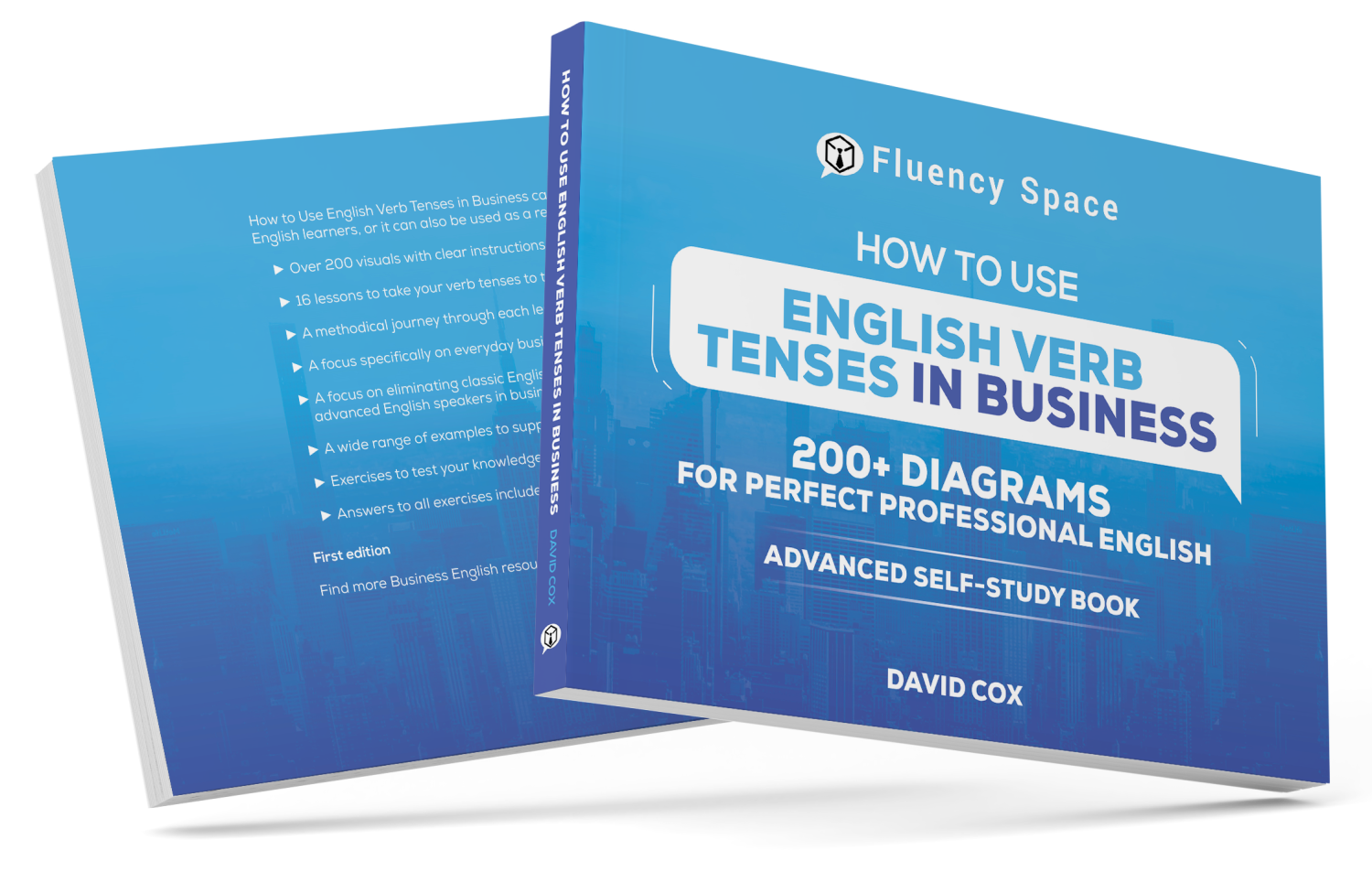
From How to Use English Verb Tenses in Business by David Cox · 200+ diagrams for professional English
The forms: no ‘will’ after ‘if’
We don’t use ‘will’ with ‘if’. We use the present simple instead, and we don’t use ‘will’ until the other part of the sentence. This is one of the most common mistakes to avoid:
| If we | win | the contract, we | will hire | two new engineers. |
| If the client | agrees | to our terms, we | will sign | on Friday. |
| If the price | is | too high, they | will go | to a competitor. |
| If I | am | late, the client | will get | annoyed. |
present simple after ‘if’‘will’ in the other part
Negative sentences
Be careful with negative sentences. Because we need the present simple in the ‘if’ part of the sentence, ‘If we won’t…’ is always incorrect:
| If we | win the contract, we’ll have to cut costs. ✗ | |
| If we | don’t | win the contract, we’ll have to cut costs. |
| If the supplier | doesn’t | deliver on time, we’ll miss the launch. |
| If I | am not | at the meeting, Anna will present. |
| If the client | isn’t | happy, we’ll offer a discount. |
| If our prices | aren’t | competitive, we’ll lose market share. |
Three common business uses
There are many good uses for this in business:
1 · Talking about future plans
What will we do if something happens?
If they don’t accept our first offer,
‘If’ + present simple to talk about a possible future event, which may or may not happen
we will lower the price.
‘Will’ to talk about a future event which will happen if the first event happens
Other examples: If the board approves the budget, we’ll hire three new developers. If the flights are too expensive, we’ll hold the meeting online.
2 · Making suggestions for the future
What will be the result if we do something?
If we increase the price by 2%,
‘If’ + present simple to talk about a possible future event, which may or may not happen
we will be able to make $3 million extra profit next year.
‘Will’ to talk about a future event which will happen if the first event happens
Other examples: If we go by train, we will save a lot of money. If we leave early, we’ll have time to get lunch before the meeting. If we post this video, it will be great for our brand image. I believe that if we organise a weekend away with everyone in the team, it will really bring them closer together.
3 · Giving warnings about the future
What will happen if something does – or doesn’t – happen?
If profits don’t improve soon,
‘If’ + present simple to talk about a possible future event, which may or may not happen
we will have to change our strategy.
‘Will’ to talk about a future event which will happen if the first event happens
Other examples: If we lose this client, we will lose 20% of our whole client base. If the economy doesn’t improve soon, many people will lose their jobs.
Practise this lesson
Real plan or extreme scenario? Every question gives you the context – and the context decides the answer.
Teachers: use these diagrams
You are welcome to use these diagrams in your lessons and materials. Please credit Fluency Space with a link to this page.
Diagram: Fluency Space – fluencyspace.com/grammar/verb-tenses/first-conditional-plans-and-warnings/Correct on paper is not the same as natural in the boardroom
One-to-one Business English coaching for C1/C2 executives and founders.

© Copyright Fluency Space. All Rights Reserved
OptimizePress Popup Overlay
the fluency space acadademy
Be one of the first 50 to join and get a huge discount!

Your advanced English training center. Over 600 pages of PDFs. over 250 diagrams and hundreds of exercises. 32 Vocabulary lessons covering the 400 most important phrases for advanced Business, 2x monthly Adapted Business English texts, 2x monthly YouTube listening lessons, 'How to Use English Verb Tenses in Business' textbook.
All of this and much more for only $5.99 per month. Cancel anytime!