Lesson 2.2 · Talking about the future
Future plans: which tense to use
English has no single future tense. When you talk about plans at work, the form you choose tells your listener how fixed the plan is – from a decision you have only just made to an event on the official timetable.
From How to Use English Verb Tenses in Business by David Cox · 200+ diagrams for professional English
Verb tenses with future plans
The more fixed the plan, the further up this ladder you go.
↑ Plans become more fixed
- Official plans, timetabled eventspresent simple“The event starts at 7.”
- Fixed arrangements, appointmentspresent continuous“I’m meeting him for lunch at 12.”
- Intentions. Plans not fixedgoing to“We are going to meet next week.”
- Spontaneous decisions made nowI think I will…“I think I will call a meeting later.”
Using different tenses when talking about future plans
Three plans for the same moment tomorrow – each with a different tense, because each plan is fixed to a different degree.
The conference starts at 9am tomorrow.
Present simple to talk about an official plan / event
John is going to show the guests to their seats,
‘going to’ to talk about a plan which is not yet fixed
and then I will probably give a quick welcome speech.
‘will’ to make a spontaneous plan just decided now
Timetabled events and plans not yet fixed
The timetable is fixed by someone else. Your own plan around it is not.
The flight is at 6pm,
Present simple to talk about an official, timetabled event
so we are going to leave home at around 3pm to arrive at the airport on time.
‘going to’ to talk about a plan which is not yet fixed
Using ‘I have…’ for official timetabled events
When we talk about scheduled official events or appointments, we can use ‘I have…’ in the present simple.
I have a doctor’s appointment at 5pm,
Present simple to talk about an official scheduled future event
so I’m going to leave work a little bit earlier.
‘going to’ to talk about a plan which is not yet fixed
Other examples: I have a meeting at 9. I have a conference call at 12. We have an English lesson later today at 3pm.
Mixing present and future tenses
It is also common to see the present simple twice in the same sentence with two different meanings.
The morning meeting usually starts at 9am,
Present simple to talk about a general situation / habit
but this week we are starting at 10,
Present continuous to talk about a future fixed plan(we have fixed the plan, but it is not following the usual official timetable)
because John has a conference call at 9.
Present simple to talk about an official timetabled future event
Teachers: use these diagrams
You are welcome to use these diagrams in your lessons and materials. Please credit Fluency Space with a link to this page.
Diagram: Fluency Space – fluencyspace.com/grammar/verb-tenses/future-plans/Correct on paper is not the same as natural in the boardroom
One-to-one Business English coaching for C1/C2 executives and founders.
IN-DEPTH PROPOSAL BUILT WITH CARE
A Course Built around you
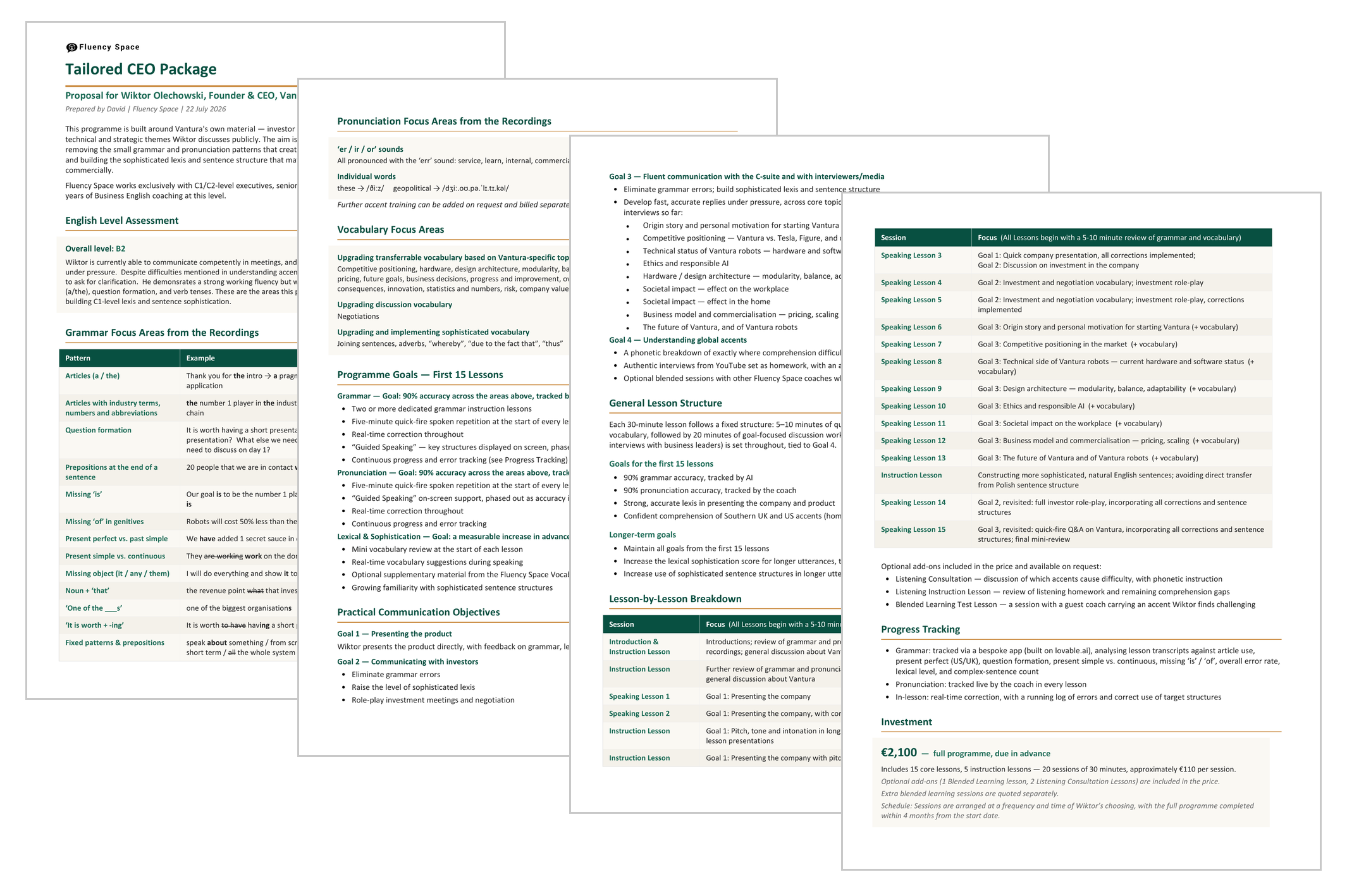
After your full English audit, we do a deep dive into your company, your role and your real communication goals - We then build a fully tailored program around them and send a proposal within 3 working days.

© Copyright Fluency Space. All Rights Reserved
OptimizePress Popup Overlay

the fluency space acadademy
Be one of the first 50 to join and get a huge discount!

Your advanced English training center. Over 600 pages of PDFs. over 250 diagrams and hundreds of exercises. 32 Vocabulary lessons covering the 400 most important phrases for advanced Business, 2x monthly Adapted Business English texts, 2x monthly YouTube listening lessons, 'How to Use English Verb Tenses in Business' textbook.
All of this and much more for only $5.99 per month. Cancel anytime!