Lesson 5 · Future from the past
Future from the past: ‘They said that they would…’
Sometimes we look forward into the future – but from a time in the past. In business this happens all the time when we report what someone said, or what we thought would happen. The key word is would.
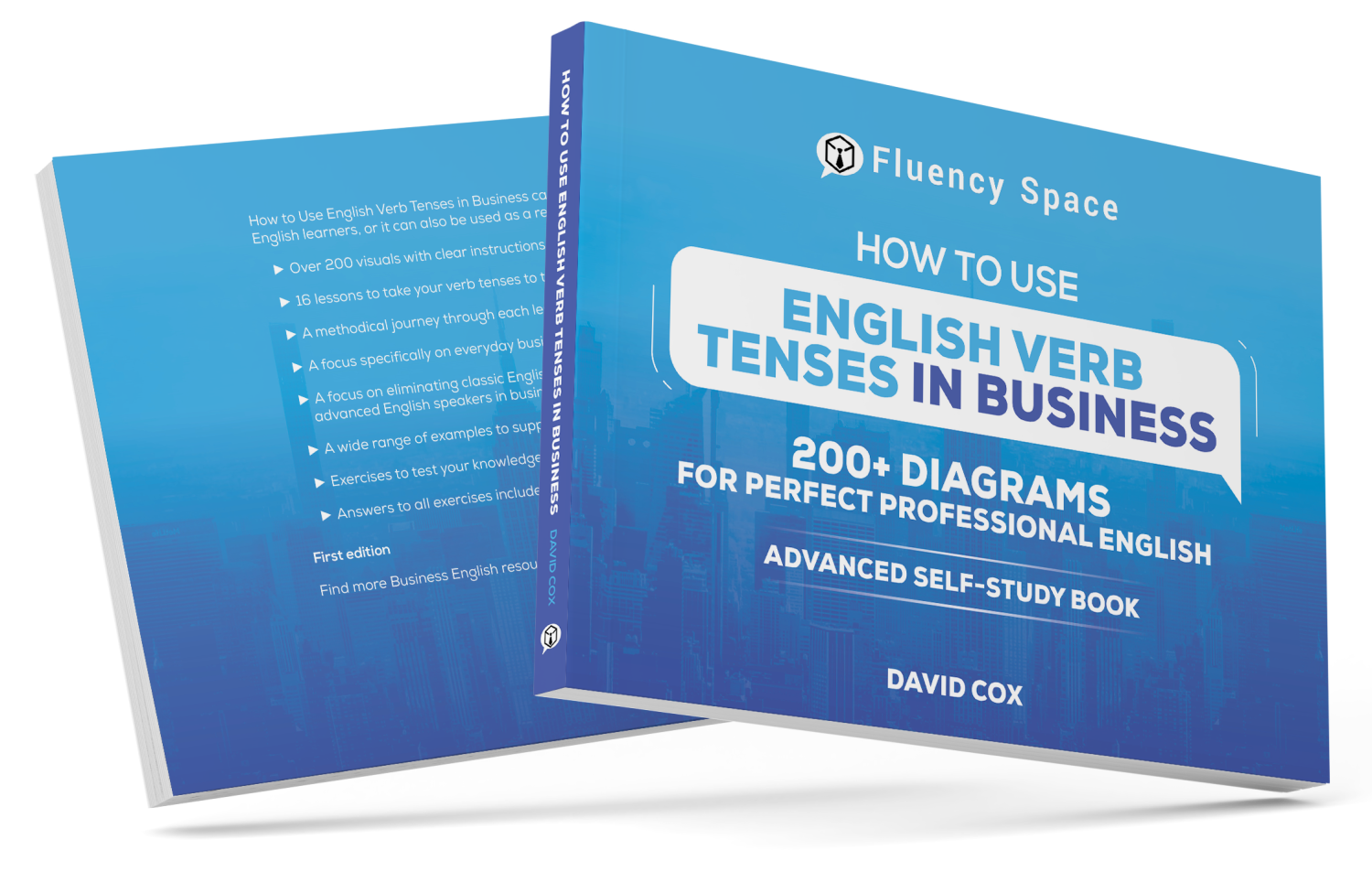
From How to Use English Verb Tenses in Business by David Cox · 200+ diagrams for professional English
Two main uses in business
The future from the past is used mainly after two kinds of verbs:
🗣️ ‘Said’ verbs: ‘He said that he would…’
When we report what someone said in the past about the future, we use would:
- He/she said that… would…
- He/she told us that… would…
- I explained that… would…
- They promised that… would…
- He/she didn’t say that… would…
- He/she didn’t tell us that… would…
We look forward into the future from a time in the past.
Many learners use ‘will’ here: “She said that she will would help us.”
Business examples: The supplier said that the parts would arrive by Friday. The CEO told us that the merger would go ahead. I explained that the new system would save us around ten hours a week. They promised that they would deliver the first version by the end of the month. He didn’t say that the budget would be cut. She didn’t tell us that the client would join the call.
🤔 ‘Thought’ verbs: ‘We thought that it would…’
When we talk about what we thought, expected or knew in the past about the future, we also use would:
- He/she thought that… would…
- We didn’t think that… would…
- We expected that… would…
- We didn’t expect that… would…
- We projected that… would…
- We predicted that… would…
- We didn’t realise that… would…
- I knew that… would…
- I didn’t know that… would…
We look forward into the future from a time in the past.
Many learners use ‘will’ here: “We thought that it will would fail.”
Business examples: She thought that the negotiations would be difficult. We didn’t think that the deal would take so long. We expected that demand would slow down after the summer. We didn’t expect that the regulator would block the acquisition. We projected that revenue would reach €5 million in the first year. We predicted that our competitors would cut their prices. We didn’t realise that the integration would be so complex. I knew that the board would approve the plan. I didn’t know that she would be at the meeting.
‘Would’ is ‘will’ from the past
We use will to look forward into the future from now. We use would to look forward into the future from a time in the past. It can help to imagine ‘would’ as the past version of ‘will’.
The supplier said that they would cut their prices.
Future from the pastThe supplier says that they will cut their prices.
Future from now‘He said that he would…’ or ‘He has said that he will…’
With ‘said’ verbs there is an important difference. If someone made an offer in the past and it is still open, we use ‘has said that… will’.
He said that he would…The offer is no longer open
Our CFO said that she would review the budget.
…and her feedback was very useful. or …but she didn’t in the end.
He has said that he will…The offer is still open
Our CFO has said that she will review the budget.
…She’s looking at it next week.
Mixing tenses: offers from the past
Our IT director said that he would set up the new system,
Past simple + ‘would’ for future from the past, to talk about a future offer made in the past
but he has had to fly to our Singapore office.
Present perfect to talk about a past event which we still haven’t moved on from (he is still in Singapore)
Thankfully, Anna has said that she will do it instead,
Present perfect + ‘will’ to talk about a future offer which has not been fulfilled yet
so I’m going to call her about it tomorrow.
‘Going to’ to talk about a future intention (Lesson 2.2)
Mixing tenses: ‘They said that they would…, but…’
I spoke to the investors yesterday.
Past simple to talk about a past event when we say ‘when’ it happened
They said that they would get back to us, but…
‘Would’ for future from the past, to talk about a future offer made in the past
…we haven’t heard from them yet.
Present perfect to talk about something which hasn’t happened yet, but may happen in the future (Lesson 3.1)
Not only offers and predictions: plans too
In business, the future from the past is most often used for offers and predictions. In the future tenses lessons, offers and predictions both use will – so here they both use would. But we can also look back at plans. Each future tense simply moves one step back into the past:
Mixing tenses: plans and offers from the past
She said that she was meeting a client,
Past simple + past continuous for future from the past, to talk about a fixed plan as seen from the past
so she didn’t attend the board meeting,
Past simple to talk about a past event which is finished (the meeting is finished)
but I’ve told her that I’ll send her a summary
Present perfect + ‘will’ to talk about an offer made in the past which could still be fulfilled in the future
of the decisions we made.
Past simple to talk about a past event which is finished (the meeting is finished)
Practise this lesson
Would or will? An offer, an intention or a fixed plan? Every exercise mixes the forms, so you always have to decide.
Teachers: use these diagrams
You are welcome to use these diagrams in your lessons and materials. Please credit Fluency Space with a link to this page.
Diagram: Fluency Space – fluencyspace.com/grammar/verb-tenses/future-from-the-past/Correct on paper is not the same as natural in the boardroom
One-to-one Business English coaching for C1/C2 executives and founders.

© Copyright Fluency Space. All Rights Reserved
OptimizePress Popup Overlay
the fluency space acadademy
Be one of the first 50 to join and get a huge discount!

Your advanced English training center. Over 600 pages of PDFs. over 250 diagrams and hundreds of exercises. 32 Vocabulary lessons covering the 400 most important phrases for advanced Business, 2x monthly Adapted Business English texts, 2x monthly YouTube listening lessons, 'How to Use English Verb Tenses in Business' textbook.
All of this and much more for only $5.99 per month. Cancel anytime!