Lesson 7.1 · Passive voice
The passive voice: ‘It has been approved’
We use the passive when we don’t say who did the action. In business, this is usually because the action was taken by an authority – a government, a regulator, a tax office, a bank – so it is obvious who did it and we don’t need to say.
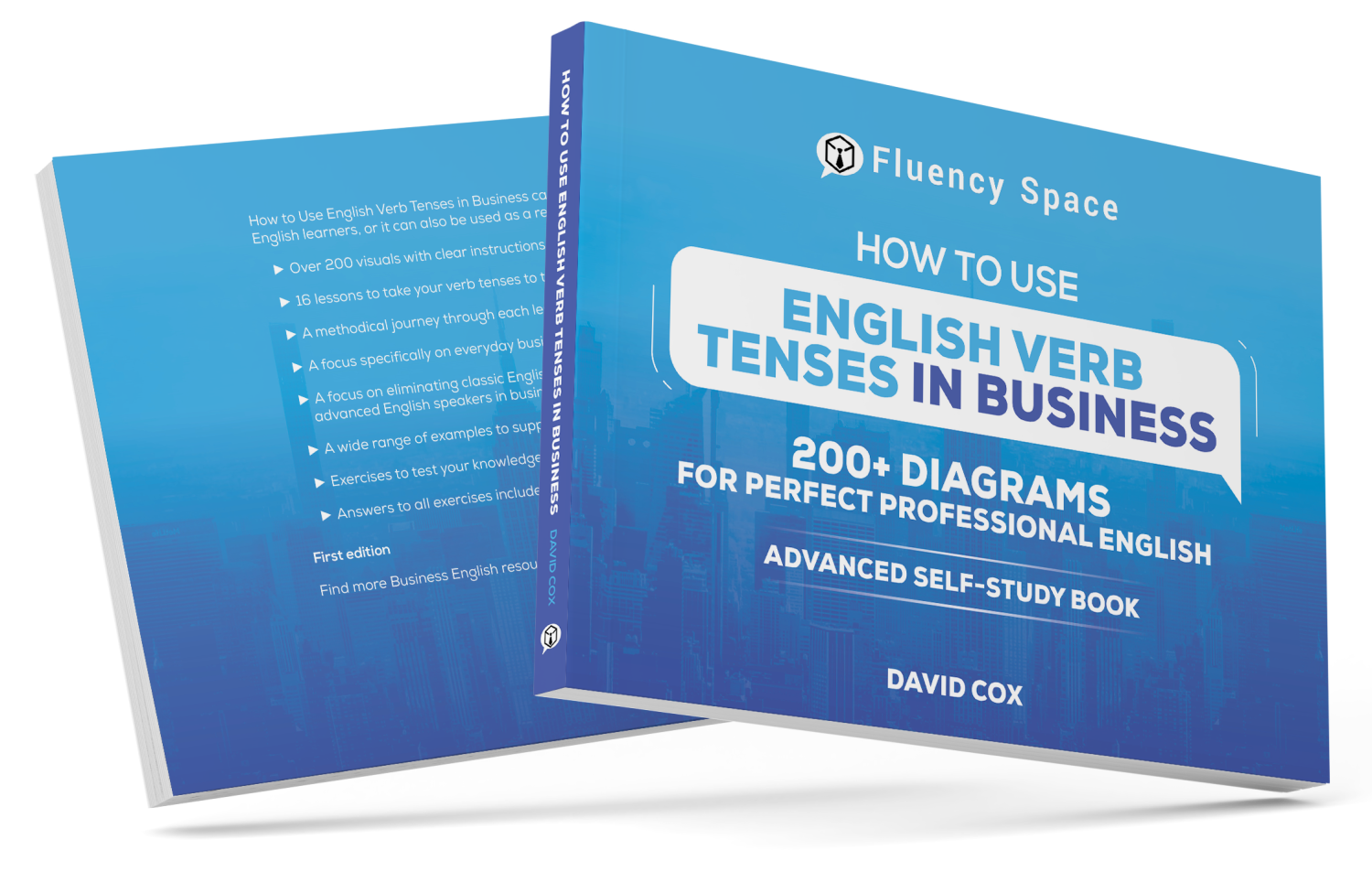
From How to Use English Verb Tenses in Business by David Cox · 200+ diagrams for professional English
Why use the passive?
The city council has approved our planning application.
Our planning application has been approved.
We make the passive with the verb be in the right tense + the past participle (approved, signed, reviewed…).
The passive in different tenses
| Tense | [be] | Past participle | ||
|---|---|---|---|---|
| Present simple: | Our tax documents | are | reviewed | every year. |
| Present continuous: | Our tax documents | are being | reviewed | this week. |
| Present perfect: | Our tax documents | have been | reviewed | |
| Past simple: | Our tax documents | were | reviewed | last week. |
| Past perfect: | Our tax documents | had been | reviewed | when we saw them. |
| will: | Our tax documents | will be | reviewed | next week. |
| going to: | Our tax documents | are going to be | reviewed | next week. |
Present simple and present continuous passives
The word ‘being’ is very important to remember in present continuous passives. As the present continuous describes temporary situations, this is very common:
is / are doneA general, long-term habit
- New policies are discussed every week.
- Plans are always formulated in advance.
- Applications are always reviewed thoroughly.
- Tech issues are always fixed as soon as possible.
is / are BEING doneA temporary situation now
- Policies are BEING discussed this week.
- A plan is currently BEING formulated.
- Your application is BEING reviewed.
- Your technical issues are currently BEING fixed.
Talking about actions taken by authorities
The following verbs are very often used to talk about actions taken by governments or authorities which may affect a business:
- has been announced
- has been reviewed
- has been approved
- has been accepted
- has been turned down
- has been agreed
- has been implemented
- has been discussed
- has been fined
Our application is currently being reviewed.
New regulations were announced last week.
A new deal has finally been agreed.
Present simple passives in action
The board holds a meeting every month,
Present simple to talk about a general, long-term habit
where all important issues are discussed.
Present simple passive to talk about a general, long-term habit
Other examples: Big companies are audited every 5 years. Important issues are debated every week in parliament.
Present continuous passives in action
We have to wait to begin the construction,
A present temporary situation, but we usually use present simple with ‘have to’
because our application for planning permission is still being reviewed.
Present continuous passive to talk about a present temporary situation
Other examples: The crisis is currently being discussed in parliament. The company are being investigated for fraud.
The present continuous passive for a fixed future plan
We are preparing some documents,
Present continuous to talk about a present temporary situation
because we are being audited next week.
Present continuous passive to talk about a fixed future plan
Other examples: The new measures are being reviewed again next week. The changes are a bit unclear. I have heard that they’re being discussed tomorrow.
Past simple passives in action
New regulations were announced last week.
Past simple passive to talk about a past event when we say ‘when’ it happened
They come into effect next year.
Present simple to talk about an official future event
Other examples: The match was cancelled last week due to bad weather. The plans weren’t discussed enough before they were implemented.
Present perfect passives in action
Planning permission for the construction has been approved,
Present perfect passive to talk about a past event which we haven’t moved on from (it has been approved, but we haven’t started the construction yet)
so we are going to begin at the start of next month.
‘Going to’ to talk about a future intention
Other examples: The issue has been discussed, but we don’t know the outcome yet. The measures have been implemented.
Talking about actions taken by your company
The passive makes your actions sound more official, but more distant from clients and colleagues. It is good for talking about contracts and admin:
- has been received
- has been approved
- has been turned down
- has been sent
- has been delivered
- has been signed
- has been reached
- has been discussed
- has been prepared
- has been solved
- has been cancelled
All information has been sent to your email.
A new deal was reached last week.
Your order will be delivered later today.
Active or passive forms in business?
Active forms
“Many thanks for your request, we will get back to you as soon as possible!”
“We have reached some kind of agreement with them.”
Passive forms
“The contract has been signed by both parties.”
“Your application has been approved.”
“A deal has been reached.”
“Your request has been received.”
Using different passive forms for your company’s actions
Your order has been received,
Present perfect passive to talk about a past event which we still haven’t moved on from (the order has been received, but not processed yet)
and it will be processed in the next few days.
‘Will’ to make a spontaneous offer / promise
Your application is being processed.
Present continuous passive to talk about a present temporary situation
You will be notified
Passive ‘will’ to make a future offer / promise
as soon as a decision is made.
Present simple passive to talk about a future event after ‘as soon as’ (Lesson 2.5)
Practise this lesson
Be in the right tense + past participle – and the right tense for authorities, admin and headlines. Test yourself with business examples.
Teachers: use these diagrams
You are welcome to use these diagrams in your lessons and materials. Please credit Fluency Space with a link to this page.
Diagram: Fluency Space – fluencyspace.com/grammar/verb-tenses/passive-voice/Correct on paper is not the same as natural in the boardroom
One-to-one Business English coaching for C1/C2 executives and founders.

© Copyright Fluency Space. All Rights Reserved
OptimizePress Popup Overlay
the fluency space acadademy
Be one of the first 50 to join and get a huge discount!

Your advanced English training center. Over 600 pages of PDFs. over 250 diagrams and hundreds of exercises. 32 Vocabulary lessons covering the 400 most important phrases for advanced Business, 2x monthly Adapted Business English texts, 2x monthly YouTube listening lessons, 'How to Use English Verb Tenses in Business' textbook.
All of this and much more for only $5.99 per month. Cancel anytime!