Business English Vocabulary · Lesson 14
Sound Sensible When Discussing Risk
From weighing up the risks to taking the leap: the phrases senior professionals use to assess, discuss and manage risk – clear, precise and easy for everyone to understand.
Homework Do all the exercises, then send your answers to your teacher at the bottom of the page.
ARead: taking a smart risk
Read the text. Pay attention to the phrases in bold – you will need them in exercise B.
How to take a smart risk
Almost every business decision comes with some kind of risk, whether it is launching a new product, entering a new market or simply hiring a new member of staff.
Before making any big decision, it is important to weigh up the potential benefits and risks, comparing them carefully. With very big decisions, it is worth taking the time to take a step back: to stop, look at the situation calmly from a distance, and think. A measured decision, based on careful thought, is almost always better than a rash one based on emotion.
If you are sure that the benefits outweigh the risks – in other words, that they are greater – you are ready to take the leap and commit to the decision, even though the outcome is not certain. A well-judged risk is likely to pay off and bring real rewards. But a rash decision can backfire, producing the opposite of what you wanted, and it may even jeopardise the company’s finances, its reputation or its very survival.
Of course, we don’t always have time for a full analysis. Sometimes we simply have to gauge the level of risk – to make a quick, intelligent judgement about how risky something is.
Some people enjoy taking risks. Others are naturally risk-averse: they prefer to avoid risk whenever possible, even if it means missing an opportunity.
BKey words from the text
Based on the context of the text, choose the phrase that matches each definition. Then complete the example sentence. You may need to change the form of the phrase.
CRead: the risk review
Now read the meeting. The phrases in bold are for exercise D.
Reviewing the Nordline acquisition
A company is planning to buy Nordline, a smaller competitor in Norway. Before the board votes, the CFO is reviewing the risks with two colleagues.
JuliaCFOThanks for joining. Before the board votes on the Nordline deal, I want to make sure we’ve covered all bases – that we’ve thought of every possible problem. Tomas, what do you see?
TomasHead of RiskI’d like to flag up three risks. First, we would be heavily exposed to currency risk. Most of Nordline’s revenue is in Norwegian krone, so a weak krone would hit our profits directly.
OwenStrategy DirectorCan we mitigate that? Reduce it in some way?
TomasYes – financial hedging would reduce the impact significantly. Second, integration. I’m wary of the timeline: I’m not convinced we can merge two IT systems in six months. And third, people. If their sales team leaves, the deal loses most of its value.
OwenThen I think we should anticipate that risk now, rather than react to it later – for example, by offering the sales team bonuses to stay before the deal closes.
JuliaGood. And can we justify the risk to shareholders? They’ll want to know why the deal is worth it.
OwenI think so. If we play it safe and do nothing, we’ll lose market share to our bigger competitors. Standing still is a risk too.
JuliaFair point. But let’s not overlook the risk to our own business: a major integration could distract the management team for a whole year.
TomasAgreed. I’ll put all of this into the risk report for Thursday.
DKey words from the meeting
Based on the meeting, choose the phrase that matches each definition. Then complete the example sentence. You may need to change the form of the phrase.
ESay it better
Each sentence below is correct, but it sounds simple. Rewrite it using a phrase from this lesson, then compare your version with the model answer.
“Let’s think about the good and bad points of this plan.”
Use: weigh up
Show model answer
“Let’s weigh up the risks and benefits of this plan.”
“We need to make the risk smaller.”
Use: mitigate
Show model answer
“We need to mitigate the risk.”
“I want to mention a possible problem.”
Use: flag up
Show model answer
“I’d like to flag up a potential problem.”
“Our CEO doesn’t like taking risks.”
Use: risk-averse
Show model answer
“Our CEO is quite risk-averse.”
“This could put the whole project in danger.”
Use: jeopardise
Show model answer
“This could jeopardise the whole project.”
“In the end, the risk was worth it.”
Use: pay off
Show model answer
“In the end, the risk really paid off.”
FKey words in a new context
A career coach is answering a reader’s question. Complete the reply with the phrases from the box. You may need to change the form of some of the words.
Use it well
Three things professionals often mix up when they talk about risk.
Verbs that go with “risk”
Before: gauge, assess, anticipate a risk.
Deciding: justify or take a risk.
Managing: mitigate or reduce a risk.
Mistakes: overlook or underestimate a risk.
And you are exposed to a risk.
Pay off or backfire?
They are opposites:
The risk paid off – we got the result we wanted. The plan backfired – we got the opposite result.Neither of them takes an object: the risk paid off (not paid off us).
Wary of, risk-averse, play it safe
Wary of + a noun or -ing: wary of borrowing more money.
Risk-averse describes a person or an organisation: a risk-averse investor.
Play it safe describes an action: this year, we’re playing it safe.
Spelling: jeopardise (UK) or jeopardize (US).
Glossary
All the phrases from this lesson.
Making a risky decision
- to weigh upto compare the advantages and disadvantages carefully
- to take a step backto stop and think about a situation calmly
- measuredcareful and controlled, based on thought rather than emotion
- to outweighto be greater or more important than something else
- to take the leapto decide to do something new or risky
- to pay offto bring good results, especially after taking a risk
- to backfireto have the opposite effect to the one you wanted
- to jeopardiseto put something in danger of being harmed or lost
- to gaugeto judge or estimate something, often quickly
- risk-aversepreferring to avoid risk whenever possible
Managing risk
- to cover all basesto deal with every possible situation or problem
- to flag upto point out a problem so that other people notice it
- exposed to riskin a position where you could be harmed or lose money
- to mitigateto reduce how harmful or serious something is
- wary ofcareful, because something could be dangerous
- to anticipate riskto expect a risk and prepare for it in advance
- to justify the riskto give good reasons why a risk is worth taking
- to play it safeto avoid risks by choosing the safest option
- to overlook riskto fail to notice or consider a risk
Send your homework
When you have finished all the exercises, copy your answers and send them to your teacher.
- Type your name.
- Press Copy my answers.
- Paste them into an email or message to your teacher.
Knowing the phrase is step one. Using it in the meeting is step two.
One-to-one Business English coaching for C1/C2 executives and founders.

© Copyright Fluency Space. All Rights Reserved
OptimizePress Popup Overlay
the fluency space acadademy
Be one of the first 50 to join and get a huge discount!

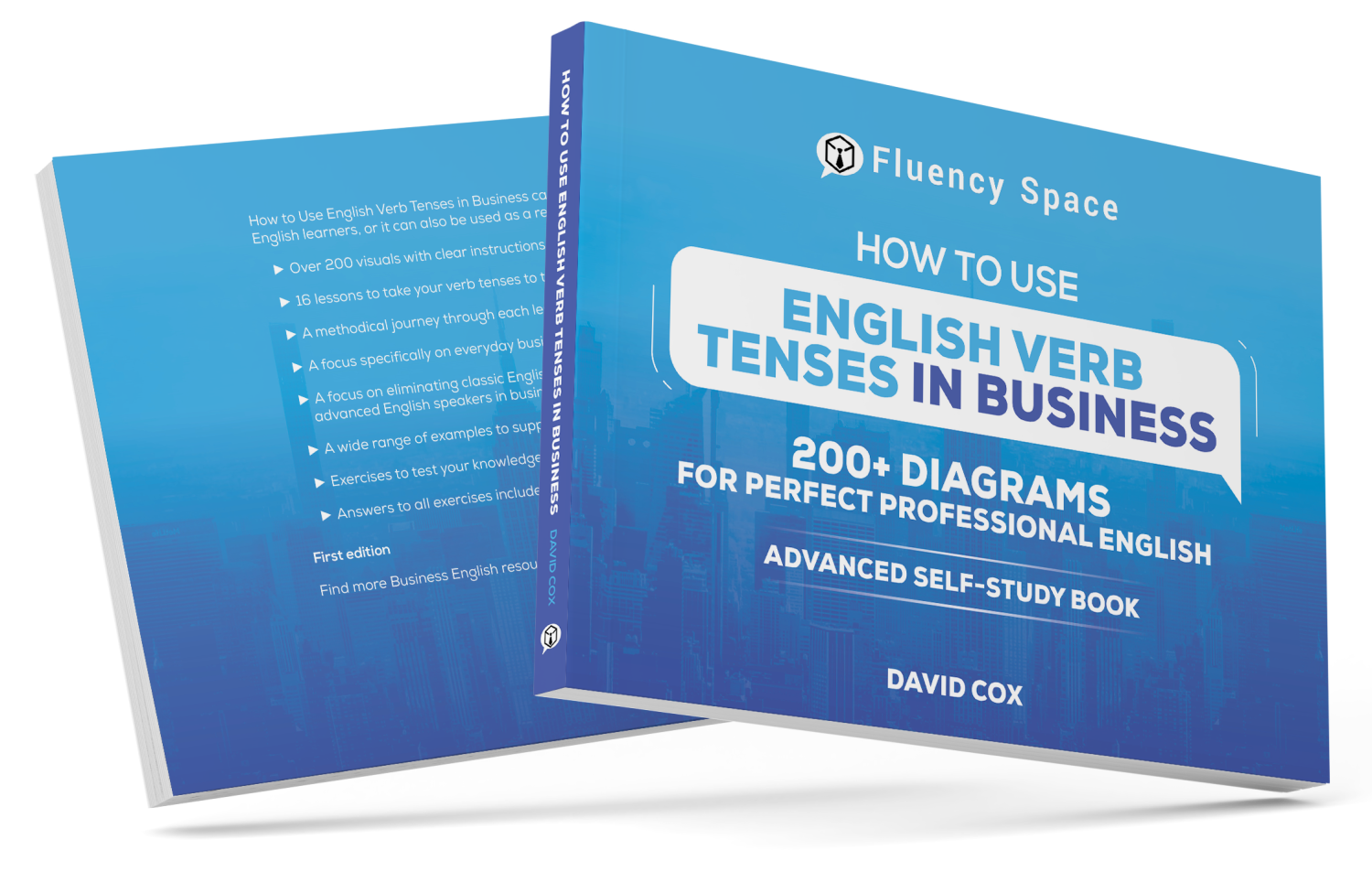
Your advanced English training center. Over 600 pages of PDFs. over 250 diagrams and hundreds of exercises. 32 Vocabulary lessons covering the 400 most important phrases for advanced Business, 2x monthly Adapted Business English texts, 2x monthly YouTube listening lessons, 'How to Use English Verb Tenses in Business' textbook.
All of this and much more for only $5.99 per month. Cancel anytime!