Business English Phrase Bank · Lesson 24
Sound Professional When Participating in Meetings
A complete phrase bank for meetings: how to agree and disagree, give your opinion, make suggestions and keep the discussion on track – professional, natural and easy for everyone to understand.
Homework Do all the exercises, then send your answers to your teacher at the bottom of the page.
Giving your view
Phrases for agreeing, disagreeing and giving your opinion – from strong to weak.
Agreeing and disagreeing
- Strong agreement
I agree 100%. / I completely agree.
- Medium agreement
I could go along with that.
- Partial agreement
I agree with you to a certain extent. However, …
- Disagreement
I see your point, but I’m afraid I can’t really agree with you there. As far as I’m concerned, …
- Strong disagreement
I’m afraid I completely disagree. As far as I’m concerned, …
Giving your opinion
- Strong
I firmly believe that … / I’m convinced that …
- General
As far as I’m concerned, we should …
I believe that … / I feel that …
If I had to name the most important …, I would say …
- Weaker
I’m leaning towards …
- No opinion
I don’t really have an opinion either way – there are advantages to both options.
Commenting on someone else’s point
That’s a very pertinent point.
I see your point.
I see where you’re coming from.
I’d just like to expand a little on that.
Expressing doubt
I’m a little bit wary about …
I have some reservations about …
Contrasting
On the one hand, … On the other hand, …
On the contrary, …
Adding to your argument
Moreover, …
Furthermore, …
In addition, …
Options and suggestions
Phrases for weighing up options, thinking strategically and suggesting what to do – now, next time, or when resources are limited.
Discussing options
I think we need to take a step back and weigh up all of our options before making a decision.
I think the benefits outweigh the risks on this one.
I’m leaning towards Option A on this one.
Discussing strategy
From a financial / marketing / customer perspective, …
We need to consider the long-term viability of …
We need to look at the bigger picture.
Making suggestions: looking forward
We would be better off + -ing
I believe we would be better off accepting their offer.Could we consider + -ing
Could we consider increasing our investment in the project?It is well worth + -ing
I believe it is well worth looking into this further – we don’t want to make a decision too quickly.If + past simple, … would …
If we accepted this client, it would open a lot of doors for us as a company.We might as well …
an unenthusiastic suggestion: we have nothing to loseWe might as well accept the offer – we have nothing to lose.Moving forward, I believe that we should …
Moving forward, I believe that we should build a strong customer base here before we expand further.We could do with …
we would really benefit fromWe could do with setting up another meeting next week.
Making suggestions: looking back
In hindsight, I think we should have …
In hindsight, I think we should have carried out more market research.If we had …, we would have …
If we had prepared more, the project would not have failed.
Making suggestions in a difficult situation
We might have to make do with …
manage with less than we would likeWe might have to make do with the current budget if we can’t get more funding.Can we get by with …?
survive withCan we get by with ten staff at the event?Let’s see if we can get away with …
do something without negative consequencesLet’s see if we can get away with increasing the price by 10%.
Offering to contribute
I could take a look at …
I’m happy to take care of …
Managing the conversation
Phrases for joining in, checking your understanding and keeping the discussion on track.
Interrupting
If I could just come in here, …
When you didn’t understand
I’m sorry, I didn’t quite catch that. Could you repeat it, please?
Clarifying
Just to make sure I’ve understood correctly, are you saying that …?
Just to clarify, are you saying / suggesting that …?
Going back in the discussion
As I mentioned earlier, …
Just going back to what we were talking about earlier, …
Giving updates
Just to fill you in on the latest regarding …
Just to bring you up to date / up to speed on …
We have completed phase 2, and we are now moving on to phase 3.
Going off topic
Sorry, I’m going a little off topic here, but it’s important to add …
Sorry, I’m digressing. Just going back to what I was saying, …
When you don’t know
I can’t remember exactly, but off the top of my head, …
Let me go away and check that, and I’ll get back to you.
I don’t have the exact figures, but as a ballpark figure, …
AWhat would you say?
Read each situation from a meeting. Which phrase would you use?
BKey expressions you can use anywhere
These expressions from the phrase bank are useful far beyond meetings. Choose the expression that matches each definition. Then complete the example sentence. You may need to change the form of the expression.
CKey expressions in a new context
Complete the article with the expressions from the box. You may need to change the form of some of the words.
Use it well
More ways to use some of the key expressions – plus three useful words from the article.
Get away with
Use it to ask how far you can push something:
Could we get away with raising prices by 15%?…or to talk about avoiding the consequences of a mistake or a broken rule:
We missed the deadline by two days, but we got away with it.It is often followed by an -ing form: She always gets away with coming in late.
Could do with
A very natural way to say that you need something. It can be followed by a noun or an -ing form:
We could do with hiring a few extra staff for the summer.For the past, use could have done with:
It was so busy last night – we could have done with more staff.To a certain extent
Change the adjective to be more precise:
to a significant / considerable extent (a lot)
to a limited / minimal extent (a little)
to a greater / lesser extent (more / less)
From the article
A flaw – a fault or a weakness: a flaw in the plan / the system / the argument. Something with many flaws is flawed.
To win someone over – to get the support of someone who wasn’t convinced. With a pronoun, split it: We won them over – not won over them.
In the aftermath of – in the period after an important (often negative) event.
Glossary
The key expressions from this lesson.
From the phrase bank
- to go along withto agree with or accept an idea or a proposal
- to a certain extentpartly, but not completely
- a pertinent pointa relevant and helpful comment
- to have some reservations aboutto have doubts about whether something is a good idea
- viabilitythe ability to be successful or to work in practice
- might as wellwe have nothing to lose by doing it
- could do withto need, or really benefit from, something
- in hindsightlooking back, after something has happened
- to make do withto manage with less than you would like
- to get away withto do something without negative consequences
- to fill someone in onto give someone the latest information
- to get back to someoneto contact someone again with information
From the article
- a flaw / flaweda fault or weakness / having faults or weaknesses
- to win someone overto get the support of someone who wasn’t convinced
- in the aftermath ofin the period after an important event
Send your homework
When you have finished all the exercises, copy your answers and send them to your teacher.
- Type your name.
- Press Copy my answers.
- Paste them into an email or message to your teacher.
Knowing the phrase is step one. Using it in the meeting is step two.
One-to-one Business English coaching for C1/C2 executives and founders.

© Copyright Fluency Space. All Rights Reserved
OptimizePress Popup Overlay
the fluency space acadademy
Be one of the first 50 to join and get a huge discount!

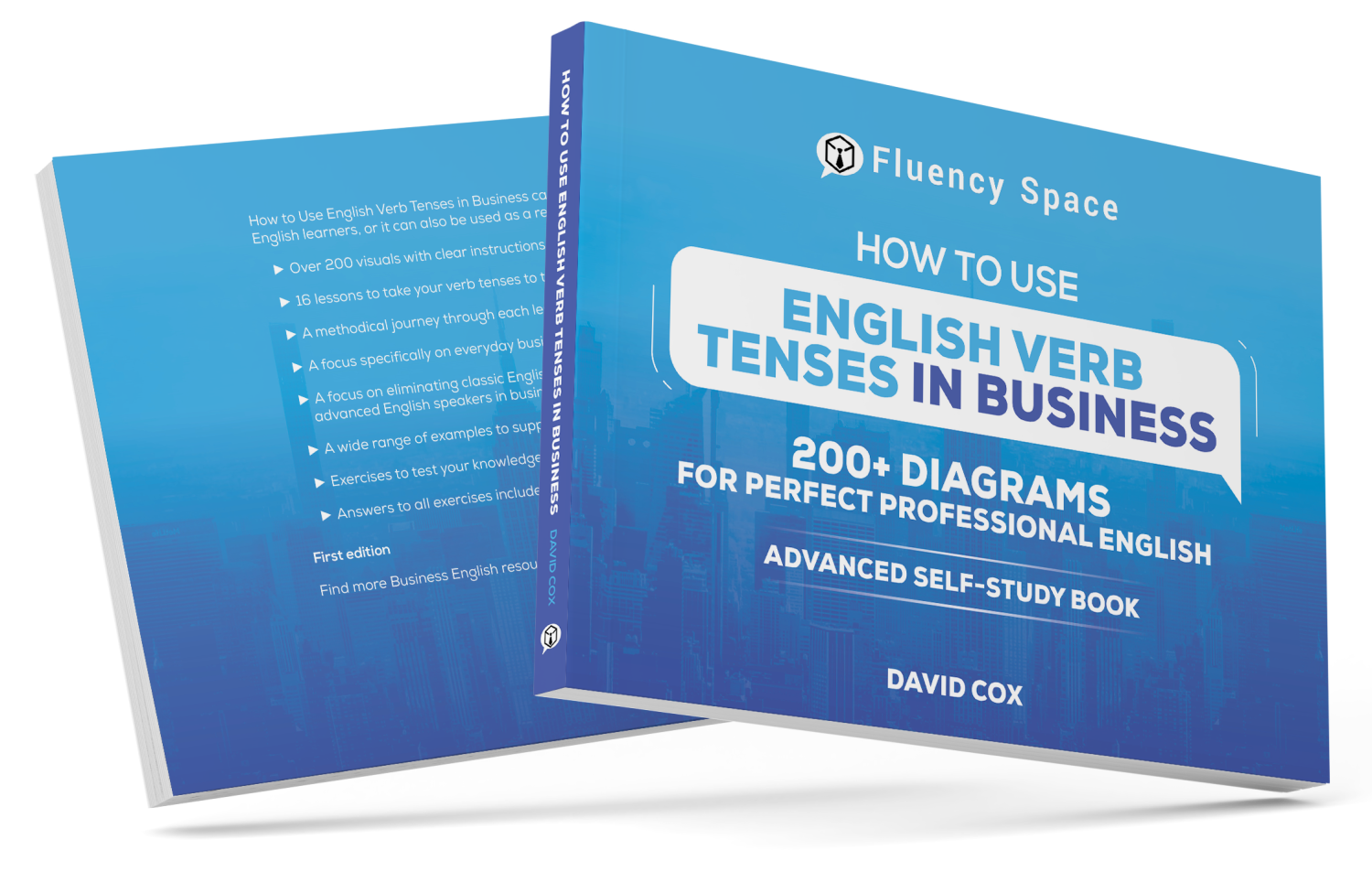
Your advanced English training center. Over 600 pages of PDFs. over 250 diagrams and hundreds of exercises. 32 Vocabulary lessons covering the 400 most important phrases for advanced Business, 2x monthly Adapted Business English texts, 2x monthly YouTube listening lessons, 'How to Use English Verb Tenses in Business' textbook.
All of this and much more for only $5.99 per month. Cancel anytime!