The Status Game: Why Nobody Ever Wins
A C1 Business English lesson on status, ambition and hidden games we play, based on the best-seller by Will Storr.
In his bestseller The Status Game, journalist Will Storr argues that the pursuit of status shapes almost everything we do, from the careers we choose to the companies we build, and that it can inspire great achievements as easily as it can lead people astray. This lesson uses Storr's ideas to build advanced business English vocabulary and critical thinking for professionals who want to understand what really motivates the people they lead.
What business leaders can learn from the story
Understanding how the status game works is a real advantage in meetings and negotiations. Recognising the motivations of others is desired, but recognising your own motivations is even more essential in order to make sensible leadership decisions. This C1 Business English lesson provides essential vocabulary for professionals discussing ambition, motivation and workplace culture, with practical exercises and a role-play.
Download Lesson
Full lesson including all exercises, answer key and gap-fill. Print-ready format.
Warm up - Before starting the Business English lesson, discuss these with a partner or your teacher.
What is the first thing that comes to mind when you hear the word ‘status’?
Based on your ideas of status, how important would you say that status is for you?
Business English Lesson Text - Underlined phrases will appear in the exercises
In his best-seller The Status Game, journalist Will Storr states that the human drive for status is so deeply ingrained that it shapes everything we do—consciously and unconsciously. However, to think that status is about wealth, power, or expensive watches is way wide of the mark. Status is purely a social construct; the way
others see us and the way we position ourselves in relation to them. Whether we are
farmers, tech experts or conspiracy theorists, the status game differs wildly and
influences our decisions, our relationships, and what we convey about ourselves to the world.
Life is a game
The behaviour of dictators, religious fundamentalists and social media stars becomes much more explainable when you realise that humans are programmed by evolution to be obsessively interested in status, and that this obsession is powerful enough to overcome the will to achieve equality, truth or compassion.
We play games for status relentlessly and automatically. As a tribal animal, our survival
and reproduction has always depended on being accepted into a supportive community. But once inside a group, we’re rarely satisfied to hang around at the bottom of the
pecking order. We’re driven to climb the ladder. Back in the stone age, increased status
meant access to better partners to reproduce with, more abundant food and greater safety. The more status we earned, the greater our capacity to thrive and produce thriving children, so we are driven to seek connection and a higher rank. This is the game of human life.
A Global Game
No matter where you might travel, from tribal societies in Papua New Guinea to the
skyscraper forests of Tokyo and Manhattan, you’ll find it: humans teaming up to play for status. In the developed world, we play political games, religious games, corporate games, sports games, cult games, legal games, fashion games, hobby games, video games, social media games, racial, gender and nationalist games. Within these
groups we strive for individual status, for respect from our co-players. These games form our identity, so it is simply not possible to opt out of every game, but we can choose which games to play.
The Dangers of Choosing the Wrong Game
The games of religion, politics, conspiracies and social media can often draw people into playing dangerous status games, whereby the more extreme your position, the higher you rise. On social media, "Rooftoppers" climb skyscrapers without safety equipment and film themselves at the edge. In this game, the more dangerous the situation, the more attention it earns. In 2017, Chinese rooftopper Wu Yongning fell from a 62-storey building in Changsha while filming, and in 2023, French climber Remi Lucidi died after falling from a Hong Kong tower block.
Ambitious people can also opt into dangerous career games. Elizabeth Holmes strove for status in the corporate world by founding a blood-testing start-up Theranos. She modelled herself on Steve Jobs, even choosing similar clothes and adopting a deep voice as she pushed for similar status. Her incredible rise brought such status as she appeared on the front of magazine covers and accumulated an estimated fortune of $4.5 billion. However, the blood testing machine unfortunately didn't work as it threw up blood test results which were way wide of the mark. In 2022 Holmes was sent to prison for 11 years for defrauding investors.
The Positives
It would be a mistake to conclude from all this that status pursuit is purely detrimental. On the contrary, almost everything we think of as “good” in the world is rooted in the
status game. In the small groups where our brains did much of their evolution, we won
prestige by showing ourselves to be beneficial to the group. The joy of status is nature’s
incentive that drives us to be useful.
One example can be found in the story of the iPhone. One executive stated that Steve
Jobs often ran into a rival Microsoft executive at social functions. This man boasted
that Microsoft had “solved computing” with a tablet device operated with a special pen. Whenever Jobs met him, he would come back to the office very annoyed, determined to show Microsoft how it was really done.
The Status Game in the Online World and the age of AI
As AI starts to overtake humanity in terms of its intelligence, humans themselves will finally lose their status as the most intelligent agents on the planet. Some, including Elon Musk himself, believe that will bring unprecedented abundance to the point where robots and AI will take care of the goods and services we need, and work becomes optional. Living in such abundance might end the status game altogether. If we all have everything, why would we need to compete? On the other hand, if the status game is so deeply ingrained in human nature, it is reasonable to expect that the game will go on, potentially in a more primitive form of achieving physical prowess or physical beauty.
In today’s online world, the status game is thrown in our faces more so than ever before, so it is useful to remind ourselves that none of us are competing with everyone in the world, even if it feels that way. It is not the final victory we should seek in order to be happy, but simple progress: the never-ending pleasure of moving in the right direction. As Will Storr concludes: "Nobody wins the status game. They're not supposed to. The meaning of life is not to win, it's to play."
Business English Lesson Vocabulary - Key Words from Context
Match each word to its definition and complete the example sentences. Full Business English lesson with the exercise can be found in the downloadable PDF.
Comprehension - Answer these questions in your own words
QUESTION 1
According to Will Storr, what is status, and why is it wrong to think that it is about wealth, power or expensive watches?
QUESTION 2
According to the text, why did status matter so much to our ancestors in the stone age?
QUESTION 3
What do the rooftoppers and Elizabeth Holmes have in common, according to the article?
QUESTION 4
Based on the context of the first paragraph about the positives of the status game, what do you think is meant by the adjective "detrimental"?
QUESTION 5
Why does the article suggest that the status game might continue, even in a future where AI provides everything we need?
Business English Lesson Vocabulary in a New Context - Fill in the gaps with words from the vocabulary section
A Sales Leaderboard
Marta (Sales Manager):
Daniel, I’d like to put a live sales leaderboard on the screens in the office. Our top performers really (1) ____________________ on recognition, and a bit of healthy competition would push everyone to (2) ____________________ for better results. Half the team already (3) ____________________ about their numbers over lunch, and the best of them chase their targets (4) ____________________ — that’s exactly the energy we need.
Daniel (HR Director):
I understand the idea, but I suspect your prediction of how people will react is way (5) ____________________. Competitiveness is deeply (6) ____________________ in some of the team, but others hate being ranked in public. If we suddenly create a visible (7) ____________________, the people at the bottom may simply lose motivation. At the very least, anyone who feels uncomfortable should be able to (8) ____________________ the leaderboard.
Discussion - Business insights and takeaways from the text
In the article, it states that it is impossible to opt out of all status games. To what extent would you agree or disagree with that statement?
Which status games are played in your industry or company, and what symbols — job titles, offices, cars, clients — do people use to show their status at work?
If AI and robots one day provide everything we need, do you think the status game will end, or will the rules simply change? What might people compete for instead?
To what extent do you believe that learning a foreign language can boost someone's status, both in personal and business life?
Discuss other ways that leaders can be led astray in our advanced Business English lesson on the Dunning-Kruger Effect.
See more on how AI will shape the workplace of the future in our advanced Business English lesson on the death of the entry level job.
Have you enjoyed this Business English Lesson? Explore more free C1 lessons in our Leadership and communication categories.
Lesson Creator

David Cox
I am a passionate linguist with over 14 years' experience with high level professionals. In this lesson you will learn:
Want to work through this lesson with me?
Advanced Premium Course
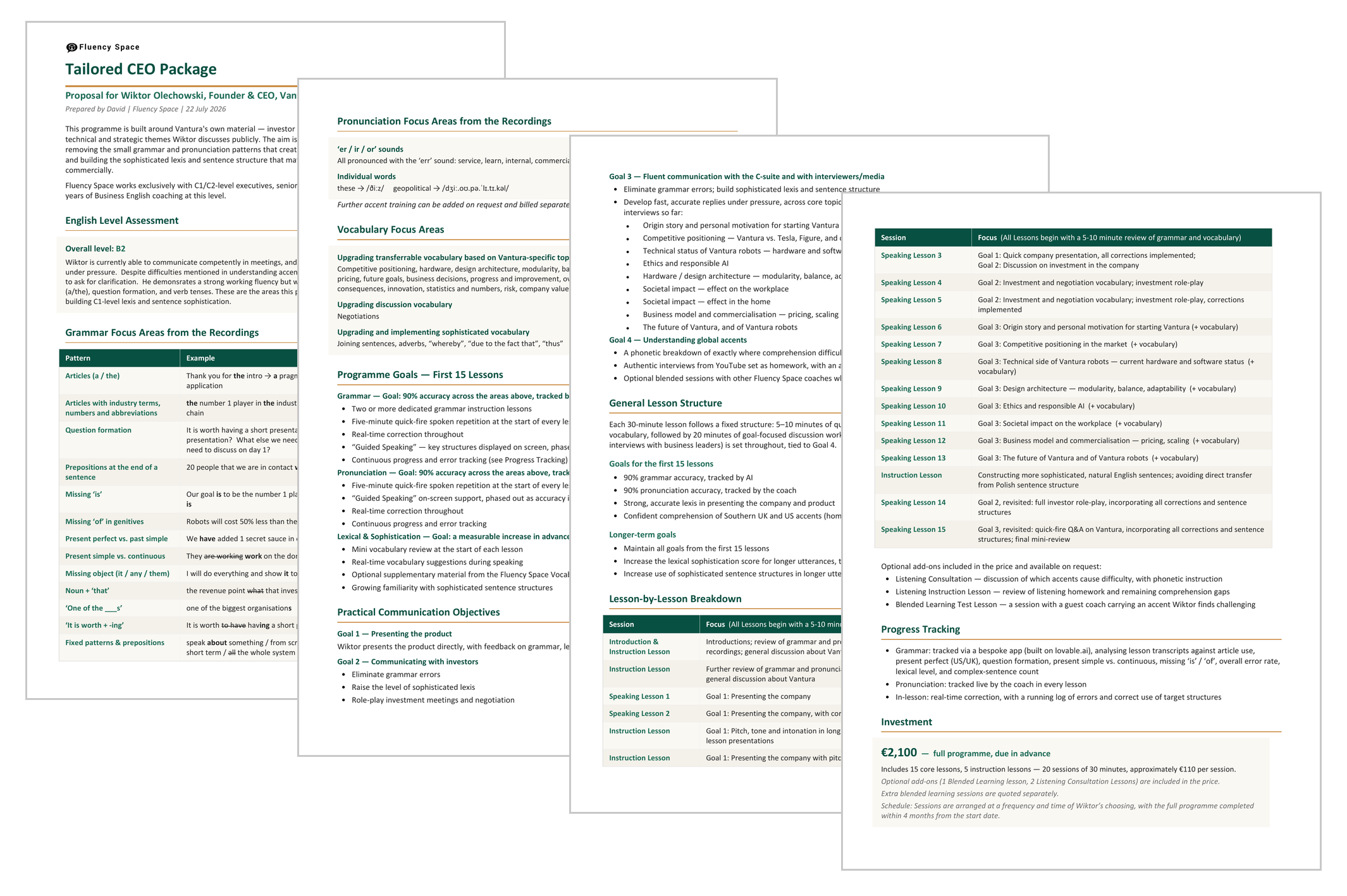
The Fluency Space CEO Package
Enjoyed this lesson? Take your business English further with a structured 3-month programme designed specifically for senior executives.
IN-DEPTH PROPOSAL BUILT WITH CARE
A Course Built around you
After your full English audit, we do a deep dive into your company, your role and your real communication goals - We then build a fully tailored program around them and send a proposal within 3 working days.

© Copyright Fluency Space. All Rights Reserved
OptimizePress Popup Overlay
the fluency space acadademy
Be one of the first 50 to join and get a huge discount!

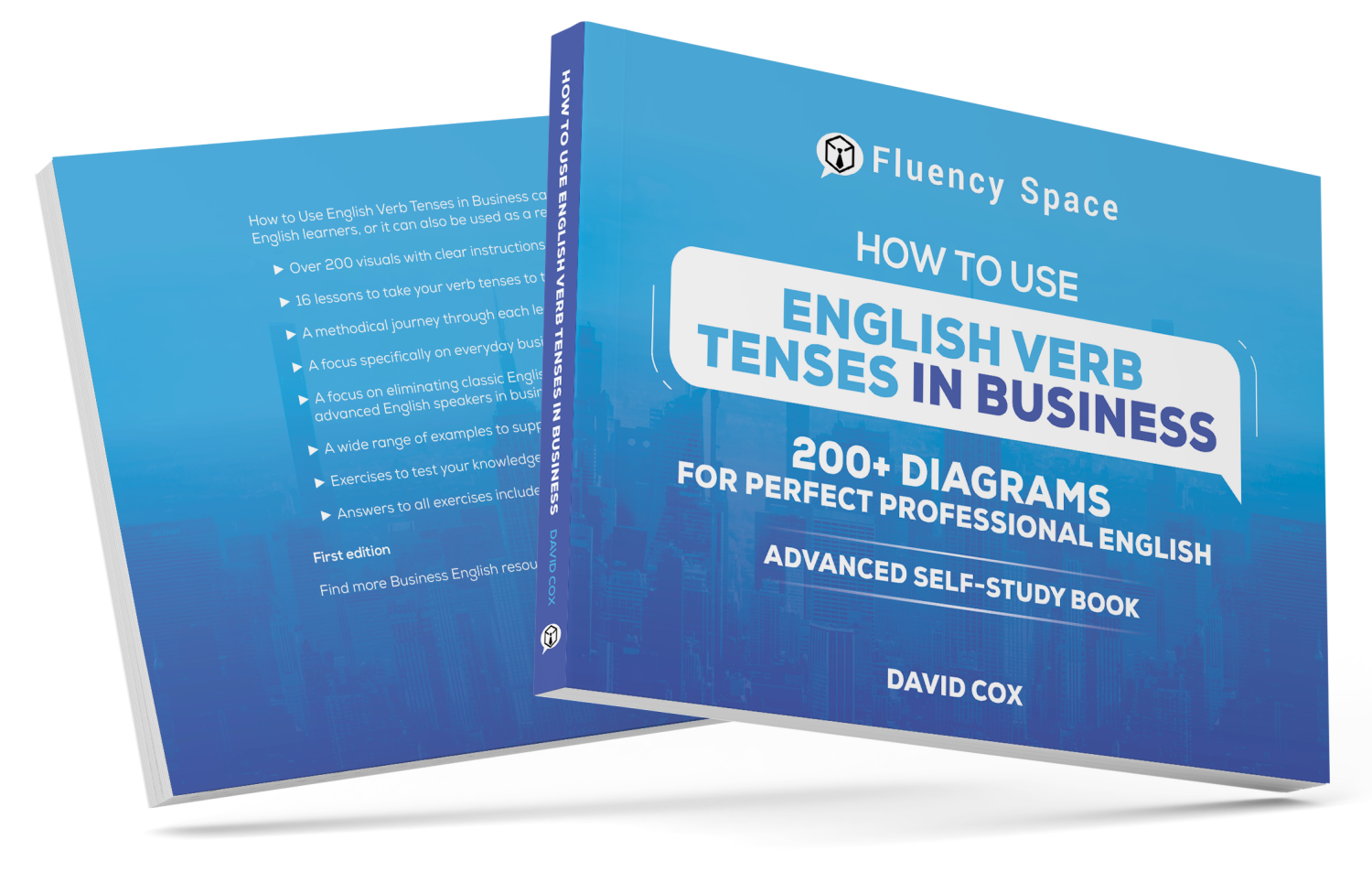
Your advanced English training center. Over 600 pages of PDFs. over 250 diagrams and hundreds of exercises. 32 Vocabulary lessons covering the 400 most important phrases for advanced Business, 2x monthly Adapted Business English texts, 2x monthly YouTube listening lessons, 'How to Use English Verb Tenses in Business' textbook.
All of this and much more for only $5.99 per month. Cancel anytime!