The Business Lesson Behind The Dunning-Kruger Effect
A C1 business English lesson on self-assessment, skill level and decisions.
In 1999, two psychologists ran a study in which they tested participants' abilities in logic, grammar and sense of humour. Participants who scored worst in these tests rated their own ability far above average, whereas participants who scored best rated themselves lower than they deserved. Twenty-five years on, the "Dunning-Kruger effect" is considered of the most significant blind spots in business: the leader who is too confident to ask the right question. This lesson uses that story to build sophisticated business English vocabulary for executives and senior professionals.
What business leaders can learn from the story
The Dunning-Kruger effect shows that when you don't know a lot about a topic, it is impossible to realise exactly how much you don't know. For confident leaders, this is a reminder of the importance of self-assessment. This C1 business English lesson explores overconfidence and the language of expertise and risk — essential vocabulary for senior professionals discussing judgement, feedback and competency.
Download Lesson
Full lesson including all exercises, answer key and gap-fill. Print-ready format.
Warm up - Before starting the Business English lesson, discuss these with a partner or your teacher.
How quickly do you pick up new skills?
How easy or difficult is it for you to maintain long-term habits?
In general, how accurate do you think people are at evaluating their own abilities and skill levels?
Business English Lesson Text - Underlined phrases will appear in the exercises
The Dunning-Kruger Effect The concept of the Dunning-Kruger effect is based on a 1999 experiment by psychologists David Dunning and Justin Kruger. Participants in the experiment were tested on their logic, grammar, and sense of humor. They were then asked to rate their own abilities in these fields. Shockingly, those who performed worst in these fields actually rated their own skills far above average, and those who performed well actually rated their ability lower than those who performed badly. Think about it: Have you ever felt as if something was really easy at the beginning? Have you ever felt that you were a natural within hours of starting something new?
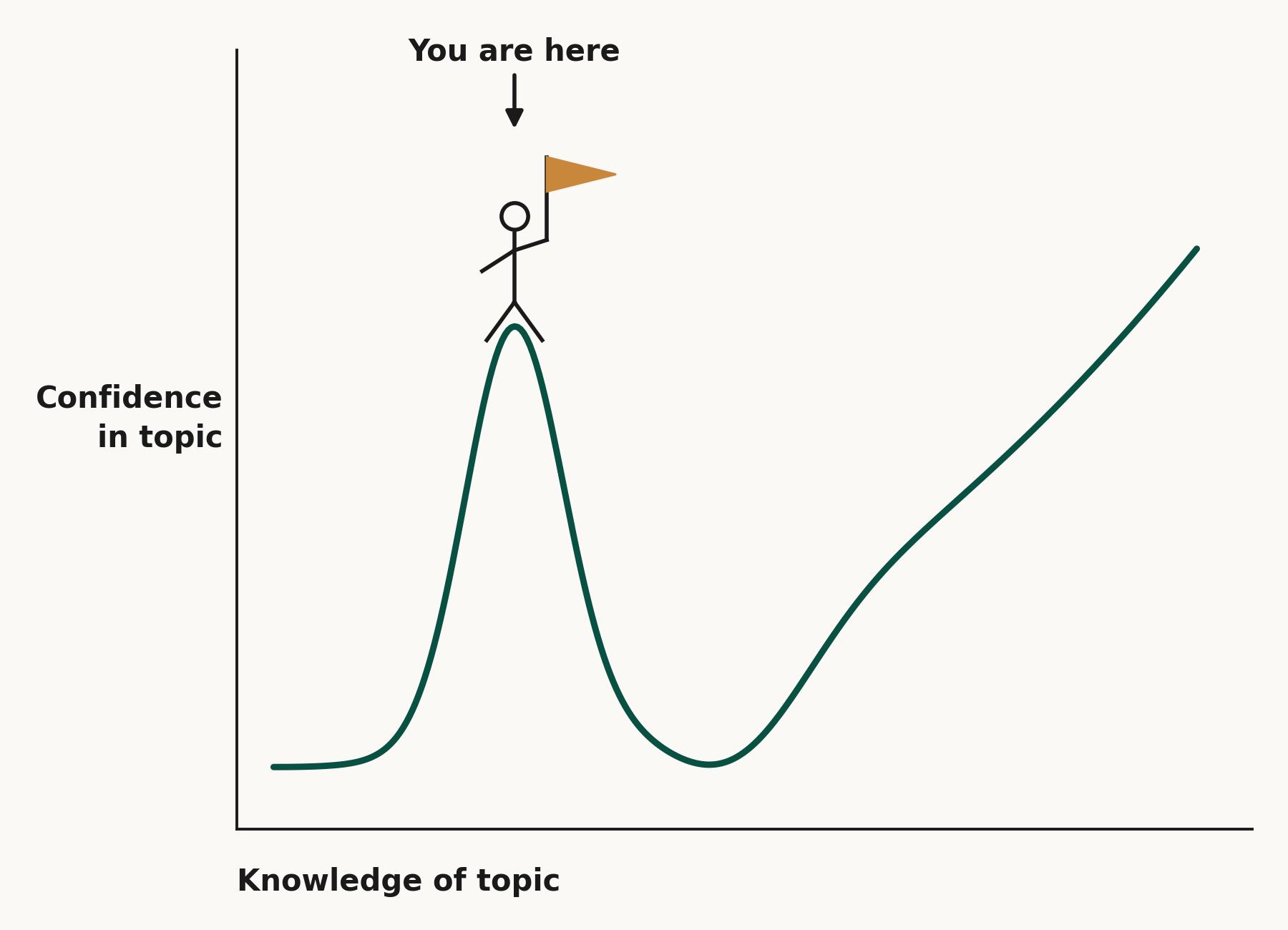
The graph below demonstrates the Dunning-Kruger effect. When you begin learning about something new or building a new habit, your confidence and enthusiasm in your ability immediately soars, because when you gain a small amount of knowledge in an area, it can make you feel as though you are suddenly an expert.
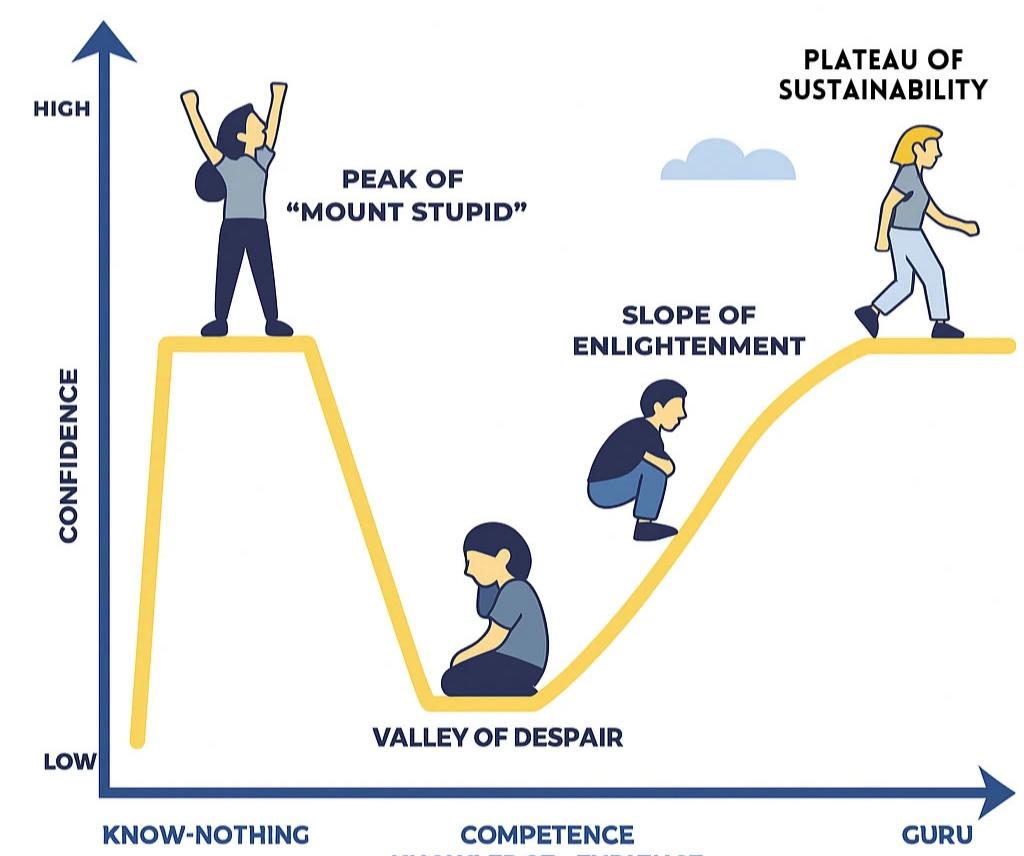
At this stage you are unaware of exactly how much you still don’t know, or how long it will take you to reach a specific goal. Congratulations, you have reached the so-called “Peak of Mount Stupid”! This confidence suddenly plummets when you learn a little bit more and you start to realise how far away you are from being competent at that skill.
You then fall into the “Valley of Despair”, which can trigger feelings of depression and frustration when you realise just how much you need to learn. New habits rarely survive this stage, and this is exactly when the excuses start, and most people quit before confidence has a chance to recover. After bottoming out, this confidence will then start to pick up as you hone your skill further. This time, however, your confidence is rising at a much more sensible rate, aligning much more closely with the increase in your knowledge.
Sitting at the top of Mount Stupid can be an extremely dangerous place. Imagine you have an idea for a new product, which you think is destined for success. Despite having little business experience, you believe your invention is going to change the world, you might completely overlook market research, competition, and invest heavily in a product that nobody wants. Overconfidence could make you blind to valuable feedback, and the startup may become a spectacular failure. Sharing your “expert” knowledge with others on social media may also lead to acute embarrassment!
In order to avoid the Dunning-Kruger Effect, David Dunning himself proposes that people should challenge their own knowledge and the perceptions of others. Of course, when you are starting something new, real expert advice can appear boring as it is too cautious, just as cautious parents appear boring to children. However cautiousness often comes from understanding and should be taken seriously. Another pitfall is to be led astray by online influencers who appear confident in order to gain attention, but only have beginner knowledge themselves, so may be on the top of Mount Stupid.
Having looked at all the pitfalls of the Dunning-Kruger effect, are there any advantages? Well, yes! The Dunning-Kruger effect increases your confidence and makes you accept challenges despite not being ready. This pushes you out of your comfort zone and drives improvement. Often, by the time your reach the “Valley of Despair” you have already invested so much time into the activity that you are unlikely to quit, and you may have already instilled useful habits to get you through that difficult period.
Successful people in any field, whether it is doctors, entrepreneurs or sports stars, need overconfidence to achieve anything. If they had known how hard they would have to work to master their chosen skills, they may never have started to learn in the first place. Congratulations, you are now an expert on the Dunning-Kruger effect.
Business English Lesson Vocabulary - Key Words from Context
Match each word to its definition and complete the example sentences. Full Business English lesson with the exercise can be found in the downloadable PDF.
Comprehension - Answer these questions in your own words
QUESTION 1
Why does confidence in your ability soar so quickly when you learn something new?
QUESTION 2
Why do people feel depression and frustration during the process of learning a skill?
QUESTION 3
What 2 pieces of advice does one of the psychologists behind the Dunning-Kruger experiment give?
QUESTION 4
When listening to people talk about a topic that you are trying to learn, what are 2 things that you should be careful of?
QUESTION 5
What are the 2 main reasons why people are unlikely to quit something when they reach the “Valley of Despair”?
Business English Lesson Vocabulary in a New Context - Fill in the gaps with words from the vocabulary section
The Dunning-Kruger Effect in Action
Picture this: As an individual with a business idea and dreams of conquering the business
world, you come across a very interesting online course: "Learn Entrepreneurship in 7 Easy Steps!" it declares in bold, vibrant letters. This immediately (1) ____________________ intense excitement. This course is just what you have been looking for.
After covering the 7 modules in the course, you will be ready to put your idea out there. The course costs around $1000, but once you follow the 7 simple steps, your income will start to (2) ____________________ anyway, so why not dive straight in.
Here is another example of the Dunning Kruger effect in action. As someone who has never tried entrepreneurship before, it is impossible to understand what it takes to be successful.
It is likely that you will be completely (3) ____________________ to the numerous (4) ____________________ of this career path, and the person selling you the entrepreneurship course may conveniently (5) ____________________ the years of hard work, stress, financial strain that many entrepreneurs have to come through to make their idea work.
What’s more, cautious words from parents and other more experienced people might fail to (6) ____________________ any sense of caution for several reasons. Firstly, cautiousness is boring; secondly, people may have extensive experience, but they are from a different era and everything has changed now; thirdly, their caution may be perceived as them failing to believe in your abilities or your idea.
The Dunning Kruger effect can therefore also cause consumers to be (7) ____________________ , especially for products which sell success. People marketing their own courses are fully aware that anyone buying a course doesn’t know a lot about the topic, so it is easy for consumers to be seduced by promises of how something can be achieved with very little time and effort.
Discussion - Business insights and takeaways from the text
When you learn a new skill, to what extent do you think your learning follows the same curve as the Dunning-Kruger effect?
To what extent do you believe that you have been influenced by the Dunning-Kruger effect, either positively or negatively?
Do you believe that it is important to understand such psychological phenomena? Why or why not?
For more business psychology insights and vocabulary, check out our advanced business English lesson about the sunk cost fallacy.
For further interesting business ideas, try our lesson on the 80/20 principle.
Have you enjoyed this Business English Lesson on industry disruption and market strategy? Explore more free C1 lessons in our Leadership and Brand & Strategy categories.
Lesson Creator

David Cox
I am a passionate linguist with over 14 years' experience with high level professionals. In this lesson you will learn:
Want to work through this lesson with me?
Advanced Premium Course
The Fluency Space CEO Package
Enjoyed this lesson? Take your business English further with a structured 3-month programme designed specifically for senior executives.
IN-DEPTH PROPOSAL BUILT WITH CARE
A Course Built around you
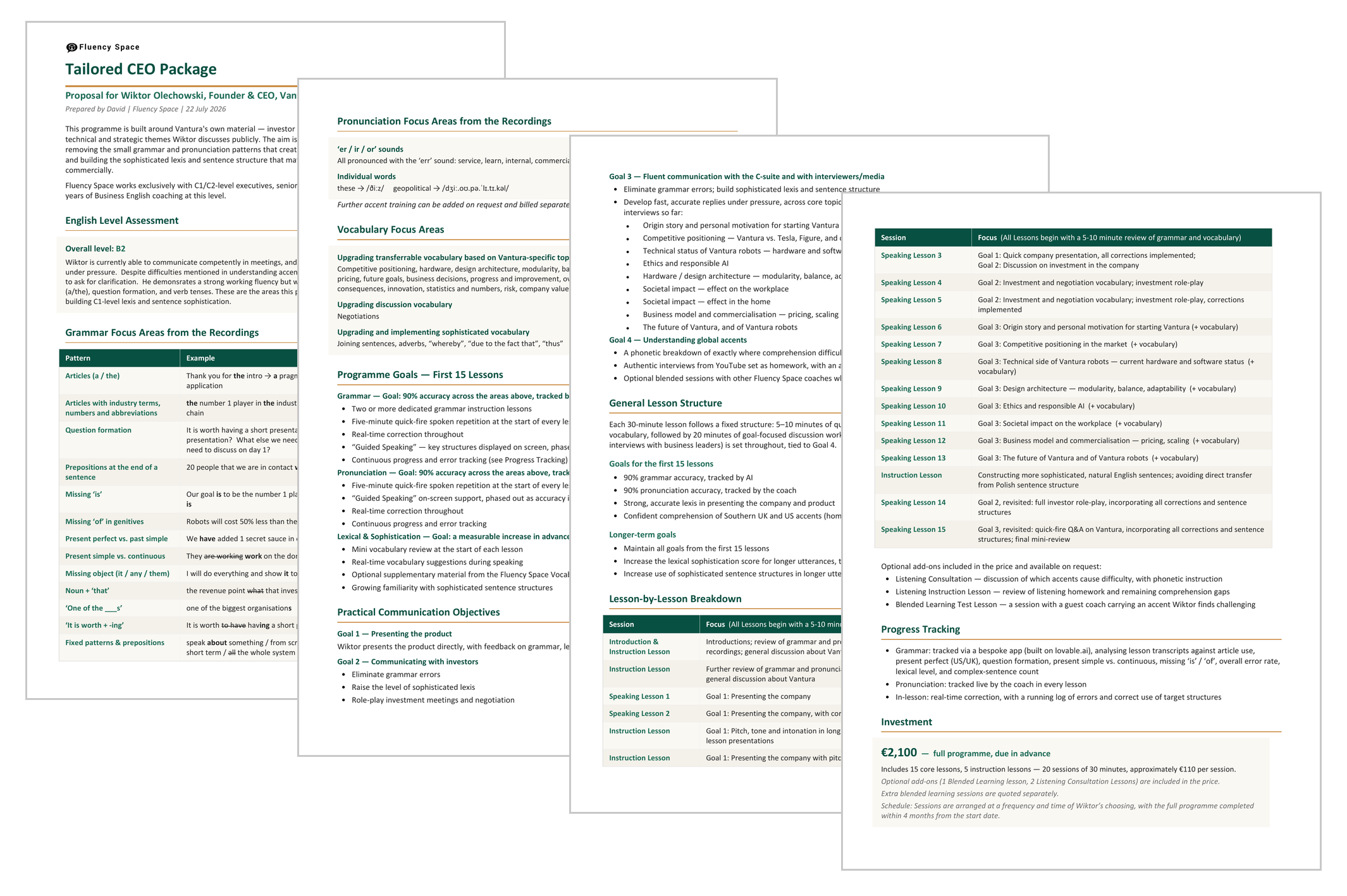
After your full English audit, we do a deep dive into your company, your role and your real communication goals - We then build a fully tailored program around them and send a proposal within 3 working days.

© Copyright Fluency Space. All Rights Reserved
OptimizePress Popup Overlay
the fluency space acadademy
Be one of the first 50 to join and get a huge discount!

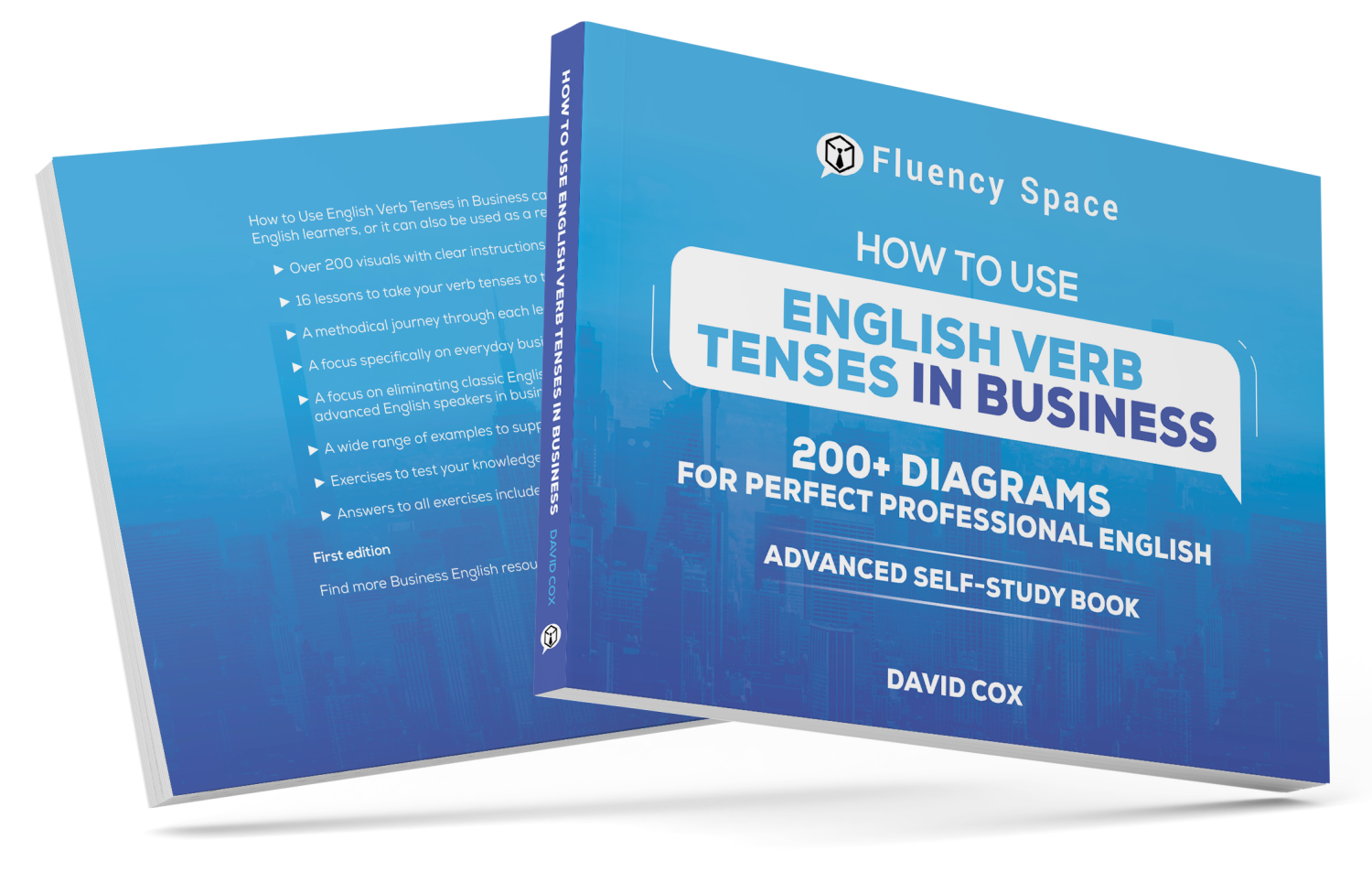
Your advanced English training center. Over 600 pages of PDFs. over 250 diagrams and hundreds of exercises. 32 Vocabulary lessons covering the 400 most important phrases for advanced Business, 2x monthly Adapted Business English texts, 2x monthly YouTube listening lessons, 'How to Use English Verb Tenses in Business' textbook.
All of this and much more for only $5.99 per month. Cancel anytime!