Business Decisions: The Sunk Cost Fallacy
A B2 business English lesson on decision-making and risk.
Executives rarely fail because they never noticed a project was struggling — they fail because they kept investing in it anyway. Psychologists call this the sunk cost fallacy: continuing to put time, money and effort into something only because so much has already gone in, not because it still makes sense. This lesson uses that idea to build practical business English vocabulary for professionals.
What business leaders can learn from the story
The lesson's message is that persistence isn't always the virtue that it is often perceived to be — sometimes it's simply the fear of admitting a mistake in disguise. Knowing when to walk away, and being able to say so clearly and persuasively, is as valuable a business skill as knowing when to push forward.
This B2 business English lesson explores decision-making, risk and the language of letting go — practical vocabulary for professionals making difficult decisions at work.
Download Lesson
Full lesson including all exercises, answer key and gap-fill. Print-ready format.
Warm up - Before starting the Business English lesson, discuss these with a partner or your teacher.
Have you ever worked on a project that wasn’t going well? How did you decide whether to continue or stop?
Can you think of a time when you stayed in a job, role, or project longer than you should
have? What kept you there?
On the other hand, have you ever quit something too early and later regretted it?
Would you consider quitting to be something which is always negative?
Business English Lesson Text - Underlined phrases will appear in the exercises
Imagine this: You have invested months of hard work, long nights, and a lot of your budget into a project, but the results are below expectations. Maybe you have spent 10 years in a career that doesn't interest you any more; or maybe you have completed two years of a three-year university course, and you have realized that it's not what you want to do. Should you press on and finish what you started or cut your losses and stop?
After so much time and resources have already been invested, the idea of walking away could seem crazy. There is a strong feeling that you should see it through because you have come this far, even when the negatives outweigh the positives. Continuing to invest time, money, or effort into something only because you have already invested a lot is known as the "sunk cost fallacy". The sunk costs are time and money that you have already invested.
The decision to press on even when it doesn't make sense comes from many factors
- Persistence, continuing something through difficult times, is often seen as a strength in business and leadership. In reality, persistence could be stubbornness, failing to accept that something is not working, when really you should quit!
- When a project was your idea, it becomes your dream, your vision, a risk that you have always supported. Quitting feels like not just losing money, but losing part of your identity or losing ground in the status game!
- Losing anything is very painful. So we press on, not because it is the smart move, but because walking away feels like admitting defeat.
- Keeping things the same feels so much safer than making a change. All change is uncomfortable, so we often put it off as long as we can, hoping that the future version of us will be braver, or at least have a better plan!
The damage from the sunk cost fallacy can be very harmful. Continuing to invest resources into bad projects can risk a company's health, leading to poor cash flow, angry investors, and in the worst-case scenario, a business that goes bankrupt. Investing time into a bad project can also mean missing other, better opportunities elsewhere.
On the other hand, people who make changes early often find new paths to growth. Many successful startups began with one idea which changed into something different after they accepted the original plan wasn't working.
Here are some signs which show that you are at risk of the sunk cost fallacy!
- You justify further investment based on past efforts rather than future prospects.
- "I'm afraid I can't go along with you there…" You disagree or ignore negative feedback because you have become too stubborn.
- You are so emotionally attached that you cannot assess the project from an outside perspective.
So how can we break free from this?
Well, we need to analyse our own brains:
- Set regular milestones or 'reality checks' to check whether a project is going well.
- Ask yourself: "If I hadn't invested anything yet, would I start this project today?"
- Get outside opinions. Bring in advisors who are not emotionally involved. They can give an honest opinion and help you see things that you might have missed.
- Accept and enjoy the change. Changing direction isn't failure—it's strategy. Many success stories started with a "failed" idea that led to a better one.
- Have an exit plan before you start. Deciding beforehand when it's time to cut your losses will make that difficult decision much easier.
Letting go doesn't mean giving up. It means making space for better ideas and smarter use of your resources. In entrepreneurship, leadership, or your career path, the ability to adapt and move on can be your most valuable asset.
Business English Lesson Vocabulary - Key Words from Context
Match each word to its definition and complete the example sentences in the exercise which can be found in the downloadable PDF.
Comprehension - Answer these questions in your own words
QUESTION 1
According to the text, what is the sunk-cost fallacy, and why is it dangerous for businesses and careers?
QUESTION 2
What are some of the 4 possible negative consequences for businesses that continue to invest in failing projects?
QUESTION 3
What do we learn in the text about young companies?
QUESTION 4
What phrase is used in the text to suggest that someone disagrees with you?
QUESTION 5
What strategies are suggested to help people break free from the sunk cost fallacy? Mention at least two.
Business English Lesson Vocabulary in a New Context - Fill in the gaps with words from the vocabulary section
A Difficult Decision
Alex (Founder):
Maya, look, we’ve been developing this app for 6 months. We’ve invested nearly half a million dollars into it, and the whole team have spent many late nights developing it. I know the user feedback hasn’t been great — they say it’s confusing, maybe not even solving a real problem — but I really believe that we should _____________________ with it. If we follow the suggestions from some users, I think that will _____________________ investing another half million into it. If we walk away now, all that time, money, and energy will feel wasted. Besides, the investors are watching. If I announce we are going to _____________________ and give up, they will lose confidence in us. To me, it feels like we need to _____________________ this through and finish what we started.
Maya (Head of Product Development):
Alex, I’m afraid I can’t agree with you on this one. From a financial _____________________, the negatives clearly _____________________ the positives. We simply don’t have the funds to keep going at the moment. If we keep being _____________________, we risk the entire company’s existence. The product no longer aligns with market demand. If we continue, we’ll not only waste money, but also time and opportunities. _____________________, if we change direction now, we might find a better path forward.
From theory to reality - check out one project that fell victim to the sunk cost fallacy in our next lesson about Mark Zuckerberg's Metaverse.
Check out further leadership psychology in this lesson about the Dunning-Kruger effect - essential knowledge for executives navigating difficult decisions.
Have you enjoyed this Business English Lesson on leadership decisions? Explore more free B2 lessons in our Leadership category.
Lesson Creator

David Cox
I am a passionate linguist with over 14 years' experience with high level professionals. In this lesson you will learn:
Want to work through this lesson with me?
Advanced Premium Course
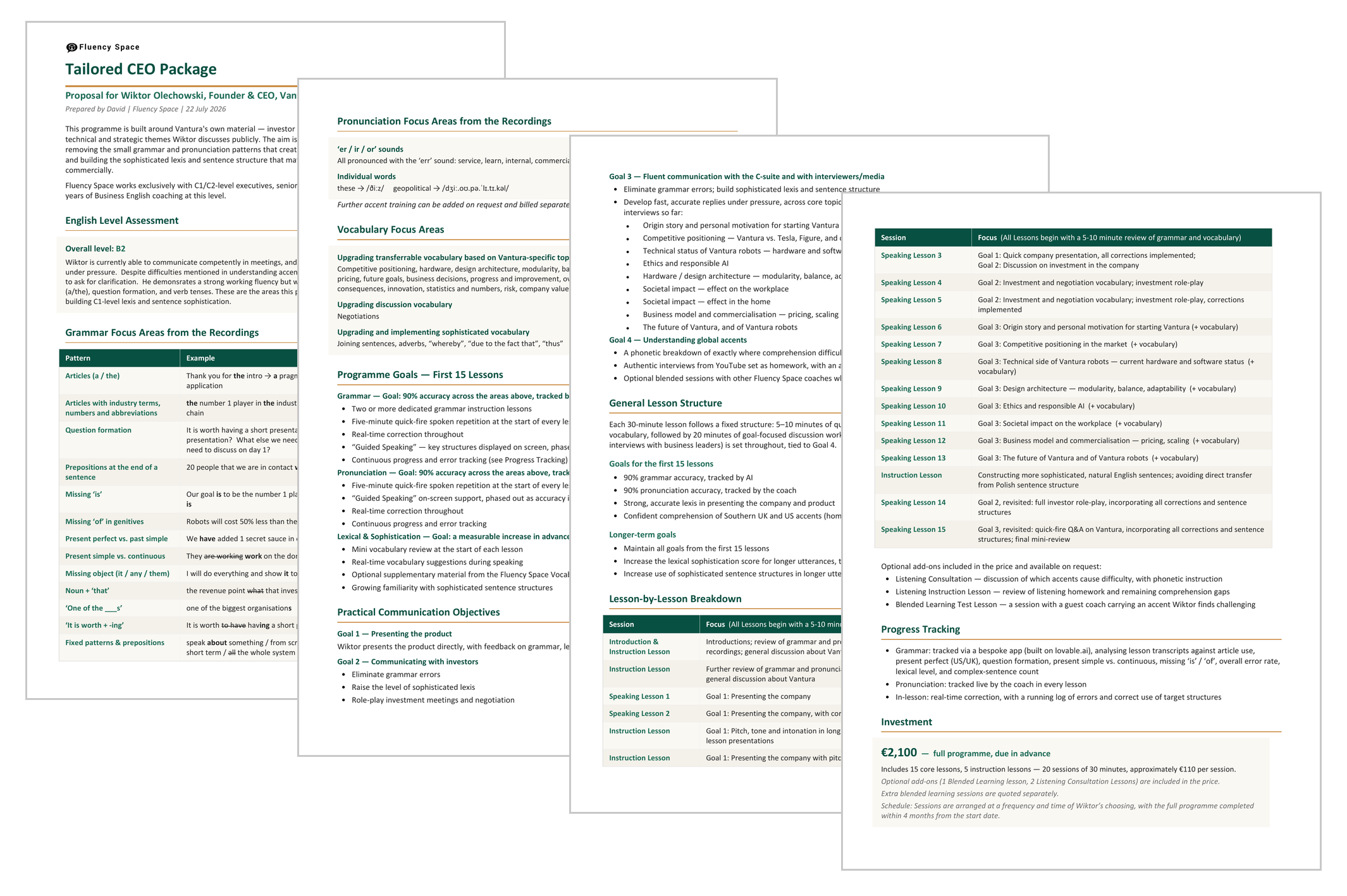
The Fluency Space CEO Package
Enjoyed this lesson? Take your business English further with a structured 3-month programme designed specifically for senior executives.
IN-DEPTH PROPOSAL BUILT WITH CARE
A Course Built around you
After your full English audit, we do a deep dive into your company, your role and your real communication goals - We then build a fully tailored program around them and send a proposal within 3 working days.

© Copyright Fluency Space. All Rights Reserved
OptimizePress Popup Overlay
the fluency space acadademy
Be one of the first 50 to join and get a huge discount!

Your advanced English training center. Over 600 pages of PDFs. over 250 diagrams and hundreds of exercises. 32 Vocabulary lessons covering the 400 most important phrases for advanced Business, 2x monthly Adapted Business English texts, 2x monthly YouTube listening lessons, 'How to Use English Verb Tenses in Business' textbook.
All of this and much more for only $5.99 per month. Cancel anytime!