Will English Ever Lose Its Global Crown as a Lingua Franca?
A C1 business English lesson on language and economics.
Today, roughly 1.5 billion people speak English as a first or additional language, making it the most dominant lingua franca in history. Despite many challenges from Esperanto, French and Chinese, English is holding onto its crown, but with the economy changing rapidly and AI transforming global communication, how long can this last? This lesson traces English's story to build sophisticated business English vocabulary and critical thinking for executives and senior professionals.
What business leaders can learn from the story
Language dominance shows that market leadership is rarely permanent. Understanding how such positions are built, consolidated and eventually challenged is essential knowledge for anyone operating in international business today.
This C1 business English lesson explores the economics of language dominance, competitive positioning and the vocabulary of market disruption — essential vocabulary for senior professionals.
Download Lesson
Full lesson including all exercises, answer key and gap-fill. Print-ready format.
Warm up - Before starting the Business English lesson, discuss these with a partner or your teacher.
What are the main languages that people learn at school in your country?
What languages do you use on a regular basis for business communication?
Why do you think that English is used as a lingua franca in business communication?
Do you believe that English will always be used for this, or will another language take its place?
Business English Lesson Text - Underlined phrases will appear in the exercises
English didn’t start out as a global language — it was once just the regional tongue of a small island nation. But over the 18th and 19th centuries it rode the waves of British colonial expansion, which gave English a foothold in territories across the 4 corners of the world, from India to the Caribbean, establishing educational systems and administrative frameworks around the language.
After World War II, the United States’ economic, scientific, and cultural successes further consolidated English’s reach across diplomacy, commerce, aviation and science. English has become so prevalent that it is now the most robust lingua franca in history, but how likely is it to stay there?
The Stats Look Impressive
In 2026, English is spoken by approximately 1.5 billion people, either as a first or additional language, and it continues to dominate international business, science, aviation, and online content. However, history shows that even once-unstoppable lingua francas eventually experience a decline.
The Fall of Latin
Latin, for example, thrived across the Roman Empire and the Western World, but eventually gave way to Romance languages such as French, Spanish and Italian. French was the dominant language of diplomacy until the mid-20th century, when geopolitical shifts and American influence began replacing it with English. These transitions took place over several decades and reflected deep shifts in political and economic power, so it is not easy to topple a dominant language.
Past Attempts to Topple English
History’s most deliberate challenge to English came from a Polish doctor named L.L Zamenhof, who built a fully workable language completely from scratch in 1887 (of course we assume it took him longer than 1 year to invent it!) Believing that linguistic division fostered tension and conflict, he created Esperanto, which had nice easy grammar and word formation rules so that young learners could pick it up quickly without irregular verbs and nouns.

He envisioned this as a global language, and while it attracted a passionate community and real native speakers, he never managed to bring his vision to fruition. The experiment proved to some extent that languages gain worldwide traction mainly through political, economic, and cultural influence rather than simplicity.
So what are the influences challenging English today?
In the early 21st century, many predicted that Mandarin Chinese would topple English as a result of China’s rapid economic rise to prominence. However, China’s population has started to decline, which may inhibit Mandarin’s expansion despite China’s ongoing economic and AI influence.
English’s strength has always been tied to economic networks, but we are now entering uncharted waters in a very unstable world, and economic centers are diversifying. While the United States and Anglophone economies remain major hubs, China’s massive market and Belt and Road partnerships have elevated Mandarin’s economic value. Meanwhile, Spanish, Hindi and Arabic are excellent candidates as their regional economies are thriving. Could economic diversification lead to a multi-lingua franca world where English remains essential but no longer the only player?
Technology and AI
Technology is rewriting how we think about language. On the one hand, English dominates online content and digital interfaces, but on the other hand, advances in artificial intelligence and machine translation are rapidly breaking down linguistic barriers. Real-time translation tools — increasingly accurate and accessible — could one day allow seamless communication without learning a second language at all. Many argue that humans still strive to learn other languages in spite of such tools in order to demonstrate discipline, commitment, competence and professionalism.
For now, English retains its crown — but the linguistic future remains dynamic and full of possibility.
Business English Lesson Vocabulary - Key Words from Context
Match each word to its definition and complete the example sentences in the exercise which can be found in the downloadable PDF.
Comprehension - Answer these questions in your own words
QUESTION 1
According to the text, how did English become a global lingua franca?
QUESTION 2
According to the article, why did Zamenhof believe that Esperanto would make the world a better place, and why did it fail?
QUESTION 3
What does the article suggest could cause a shift towards a “multi-lingua franca world”, and which languages does it mention as candidates?
QUESTION 4
According to the text, how might advances in AI and real-time translation affect the need to learn English in the future?
Business English Lesson Vocabulary in a New Context - Fill in the gaps with words from the vocabulary section. You may need to change for forms of some verbs in order to fit the meaning in the text.
Expanding into a New Market
Maria (CEO):
Daniel, our domestic growth has really slowed down this year. I think it’s time we looked seriously at Southeast Asia. If we can gain a (1) ___________________ with mid-sized retailers there early, we’ll be able to (2) ___________________ a strong position before our competitors arrive. It’s something I’ve long (3) ___________________ for this business — though I know it also means stepping into (4) ___________________ .
Daniel (Head of Strategy):
I take your point. But let’s make sure our finances are (5) ___________________ enough to absorb a slow start, and that we (6) ___________________ of this trend carefully rather than diving in headfirst. Whatever happens, we should always (7) ___________________ to put our existing customers first.
Discussion - Business insights and takeaways from the text
Do you think a single global lingua franca is a good thing for international business, or does it give native English speakers an unfair advantage? Why?
How long do you believe that English will remain a global lingua franca, and what languages do you think could replace it?
If AI translation tools became perfect and instant, would you still choose to learn a foreign language for career or personal reasons? Why / why not?
For more content on the global economy, check out our lesson on the flying geese economic model.
This lesson touches upon how AI might change English's role as a global lingua franca. For more AI discussion, check out our advanced Business English lesson on how AI is changing the structure of the career ladder and entry level job opportunities.
Have you enjoyed this Business English Lesson on English as a lingua franca? Explore more free C1 lessons in our communication categories.
Lesson Creator

David Cox
I am a passionate linguist with over 14 years' experience with high level professionals. In this lesson you will learn:
Want to work through this lesson with me?
Advanced Premium Course
The Fluency Space CEO Package
Enjoyed this lesson? Take your business English further with a structured 3-month programme designed specifically for senior executives.
IN-DEPTH PROPOSAL BUILT WITH CARE
A Course Built around you
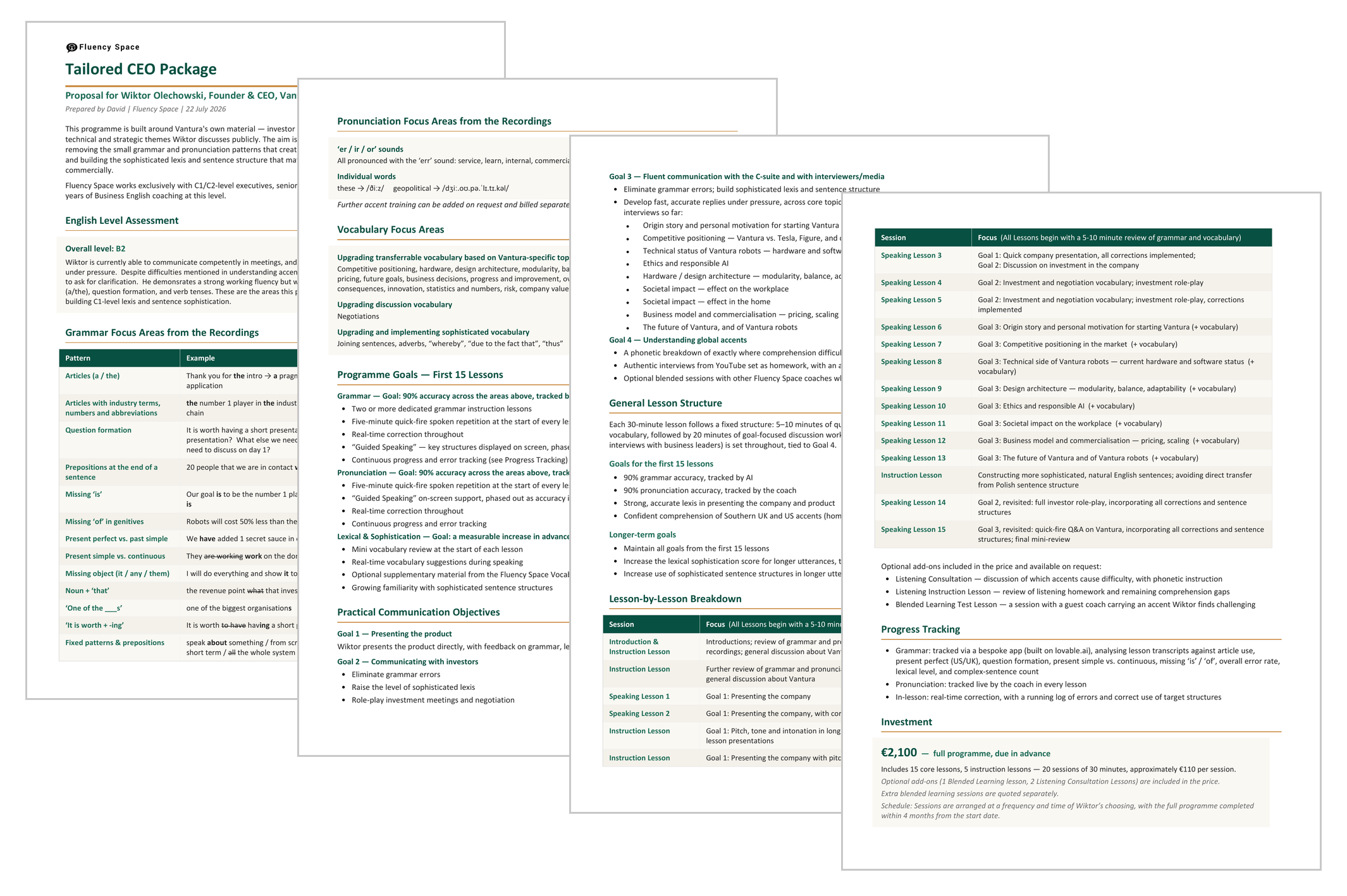
After your full English audit, we do a deep dive into your company, your role and your real communication goals - We then build a fully tailored program around them and send a proposal within 3 working days.

© Copyright Fluency Space. All Rights Reserved
OptimizePress Popup Overlay

the fluency space acadademy
Be one of the first 50 to join and get a huge discount!

Your advanced English training center. Over 600 pages of PDFs. over 250 diagrams and hundreds of exercises. 32 Vocabulary lessons covering the 400 most important phrases for advanced Business, 2x monthly Adapted Business English texts, 2x monthly YouTube listening lessons, 'How to Use English Verb Tenses in Business' textbook.
All of this and much more for only $5.99 per month. Cancel anytime!