The Flying Geese who Shaped Modern Economic Thinking
A C1 business English lesson on global trade and economic strategy.
In the 1930s, a Japanese economist studying trade graphs noticed a rather familiar pattern: a V shape which looked just like geese flying in the sky. That shape gave rise to one of the most prevailing theories in how manufacturing moves around the world. This advanced Business English lesson uses the flying geese theory to build practical business English vocabulary around trade and economics.
What business leaders can learn from the story
The lesson's message is that no advantage lasts indefinitely. In a sense, almost everything is rented, so knowing when a position is temporary and preparing for what comes after it is a valuable strategic skill.
This Business English lesson explores global trade, competitive strategy and the language of economic change — practical vocabulary for professionals following the ever-shifting economic map.
Download Lesson
Full lesson including all exercises, answer key and gap-fill. Print-ready format.
Warm up - Before starting the Business English lesson, discuss these with a partner or your teacher.
Where do you think the majority of your clothes or electronics are made?
Why do you think companies move their factories from one country to another?
Do you think robots and automation will change where products are made in the future? How?
Business English Lesson Text - Underlined phrases will appear in the exercises
If you ever see a group of geese flying together, you will notice that the group arranges itself into a V-shape whereby one bird leads at the front, cutting through the air resistance, while the rest stay behind, each benefiting from the draft of the one ahead. Eventually the leader gets tired, drops off, and another takes its place at the front.
Such an image is so common in Japanese art and poetry that Japanese economist Kaname Akamatsu used it to describe his economic theory. When studying graphs about various industries’ imports and domestic production, he noticed a prevailing V shape pattern, which appeared again and again. He named this his “flying geese” model of manufacturing.
Flying Geese Economic Theory
The basic idea is straightforward. A country industrialises by making relatively simple goods such as textiles, toys and basic electronics more cheaply than richer countries. Foreign investment pours in, factories are built, and everyone benefits: the country gets jobs and rising wages, and the rest of the world gets cheap goods. However, as wages start to climb, the country becomes less competitive at the cheap end of manufacturing, and the work moves to wherever labour is now cheaper. The lead goose falls back and a new one picks up the front.
1950s Japan was the original lead goose, building its economy on textiles and simple manufactured goods. By the 1960s, rising Japanese wages pushed that role on to the Asian “Tigers” — South Korea, Taiwan, Hong Kong and Singapore — while Japan moved up into cars and electronics. By the 1990s, the Tigers had grown wealthy enough to price themselves out of the cheapest tier too, and the formation shifted towards China. Now, the geese are moving to Vietnam, Bangladesh and India.
What happens to the lead goose who inevitably drops off?
The consensus among economists is to use the years at the front to build something that doesn’t depend on being cheap. The Japanese government poured money into education and built more sophisticated industries to take over by the time they had priced themselves out of cheap textiles. The same pattern occurred in South Korea, giving rise to Samsung, Hyundai and LG. The lead goose changed jobs before it had to drop out of formation.
The least fortunate outcome is simply standing still. Indonesia’s manufacturing sector has been shrinking since the early 2000s, but the workforce hasn’t fully found anywhere else to go. Economists have reached a consensus that without serious investment in education, domestic research, and firms capable of owning a global market, a country can be left holding neither the cheap jobs, which have moved on, nor the sophisticated ones, which never arrived. That stagnating middle ground is what development economists call the “middle-income trap.”
The forces out to disrupt the geese
One man’s attempt to overhaul the natural system to bring its geese back to the front again is impossible to escape in world media. Donald Trump and his sweeping tariff regimes are aiming to counter the natural migration of manufacturing. The US has poured over $7 trillion into bringing manufacturing back to the US, as some industries such as semiconductors are seen as too important to leave.
Robotics is also set to disrupt the geese dramatically. A robotic assembly line doesn’t ask for a pay rise (yet), so if the capital cost of automating a plant in a rich country drops off as automation costs fall, it can outcompete a cheap country. The lead geese would then stay at the front forever, with no next country waiting for its turn.
However, all countries have the potential to automate. China now installs more than half of all new industrial robots worldwide, and Vietnam is automating specifically to defend its export industry after growth picked up sharply in the early 2020s. We could see an alternative scenario whereby the geese continue to be replaced, but this time they are all armed with robots, and whoever adopts fastest stays competitive over those who stay cheapest. (I can’t imagine many Japanese poems about that).
So the next time you wonder where your sneakers were made, try some birdwatching (or Japanese poetry) and you may find the answer.
Business English Lesson Vocabulary - Key Words from Context
Match each word to its definition and complete the example sentences in the exercise which can be found in the downloadable PDF.
Comprehension - Answer these questions in your own words
QUESTION 1
According to the text, what is the “flying geese” model, and how did Kaname Akamatsu come up with the idea?
QUESTION 2
According to the article, what did South Korea do differently that allowed it to avoid the “middle-income trap”?
QUESTION 3
What two forces does the article describe as currently disrupting the flying geese pattern?
QUESTION 4
According to the text, why might automation mean that “the lead geese stay at the front forever”?
Business English Lesson Vocabulary in a New Context - Fill in the gaps with words from the vocabulary section. Two of the words are used twice, each time with a different meaning.
Automating the Factory Floor
Priya (Operations Director):
Tomasz, I really think it’s time we (1) _________________ our production line properly. Labour costs at the current site have noticeably (2) _________________ over the last two years, and if we don’t modernise soon, cheaper competitors abroad will simply (3) _________________ us. Our margins are already (4) _________________, and I don’t think that trend is going to reverse on its own.
Tomasz (CFO):
I hear you, but let’s not rush this. If we bring in a (5) _________________ restructuring plan without proper testing, we could lose control of quality. I’d rather bring in a specialist team to (6) _________________ the automation project once we’ve piloted it in one plant, and use the results to (4) _________________ any objections from the board. Otherwise, if the pilot fails, we risk (4) _________________ the shortlist for next year’s capital budget entirely.
Follow up - Advanced discussion questions for this Business English Lesson.
How long do you think it will be before we reach a point where factory automation becomes cheap enough that it will replace the human workforce, and what effect do you think this will have on the manufacturing economy?
As China is now transitioning from making cheap goods to making higher quality cars and software, what is your perception of “made in China”, and how long do you think China will need to shake off the low-end image of its products?
Find out one other surprising aspect driving the global economy in our advanced English lesson on the most underrated invention in economic history.
Check out further principles applied to the economy in our Business English lesson about the 80/20 principle.
Have you enjoyed this Business English Lesson on leadership decisions? Explore more free B2 lessons in our global economy category.
Lesson Creator

David Cox
I am a passionate linguist with nearly 15 years' experience with high level professionals. In this lesson you will learn:
Want to work through this lesson with me?
Advanced Premium Course
The Fluency Space CEO Package
Enjoyed this lesson? Take your business English further with a structured 3-month programme designed specifically for senior executives.
IN-DEPTH PROPOSAL BUILT WITH CARE
A Course Built around you
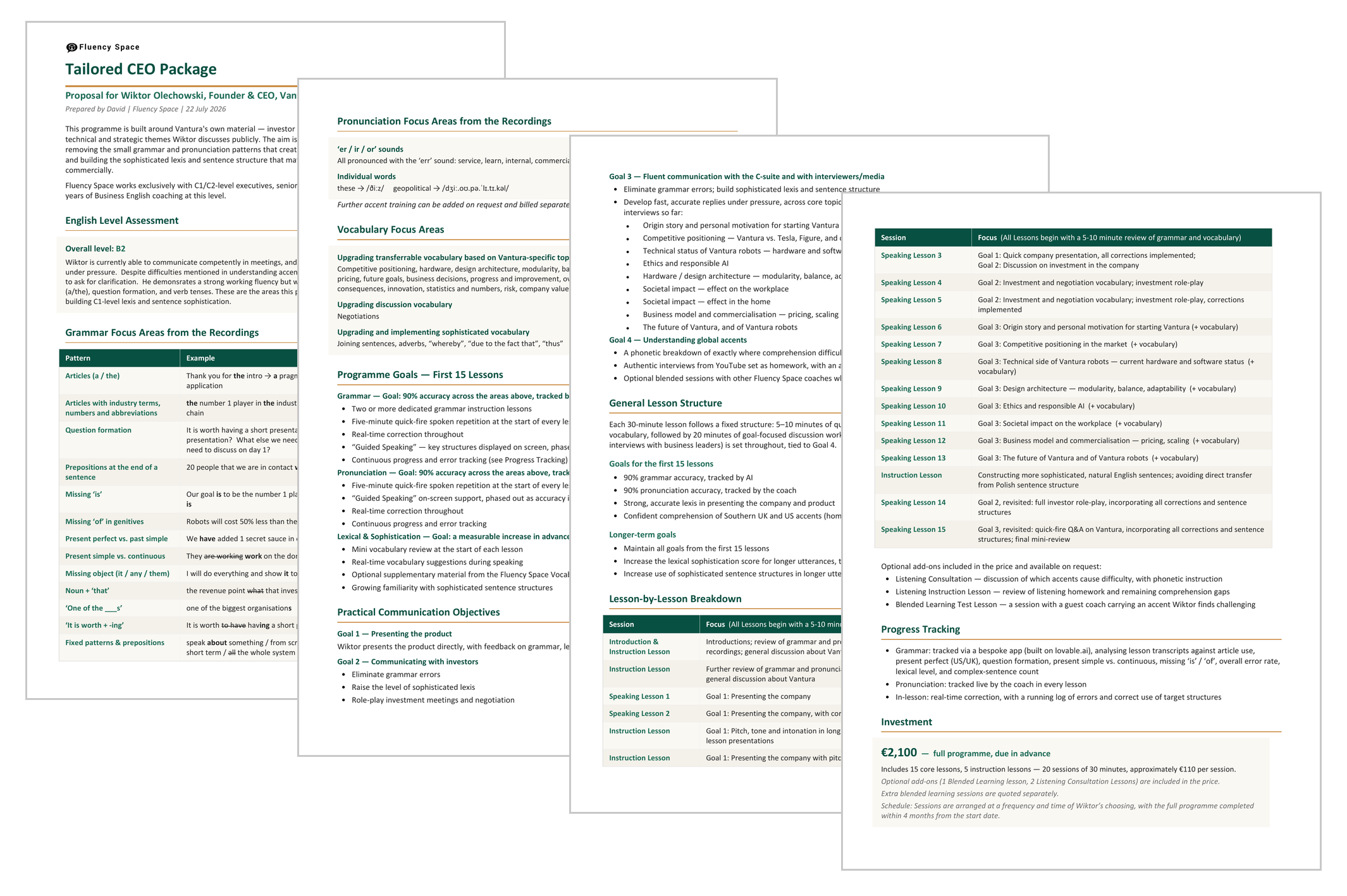
After your full English audit, we do a deep dive into your company, your role and your real communication goals - We then build a fully tailored program around them and send a proposal within 3 working days.

© Copyright Fluency Space. All Rights Reserved
OptimizePress Popup Overlay
the fluency space acadademy
Be one of the first 50 to join and get a huge discount!

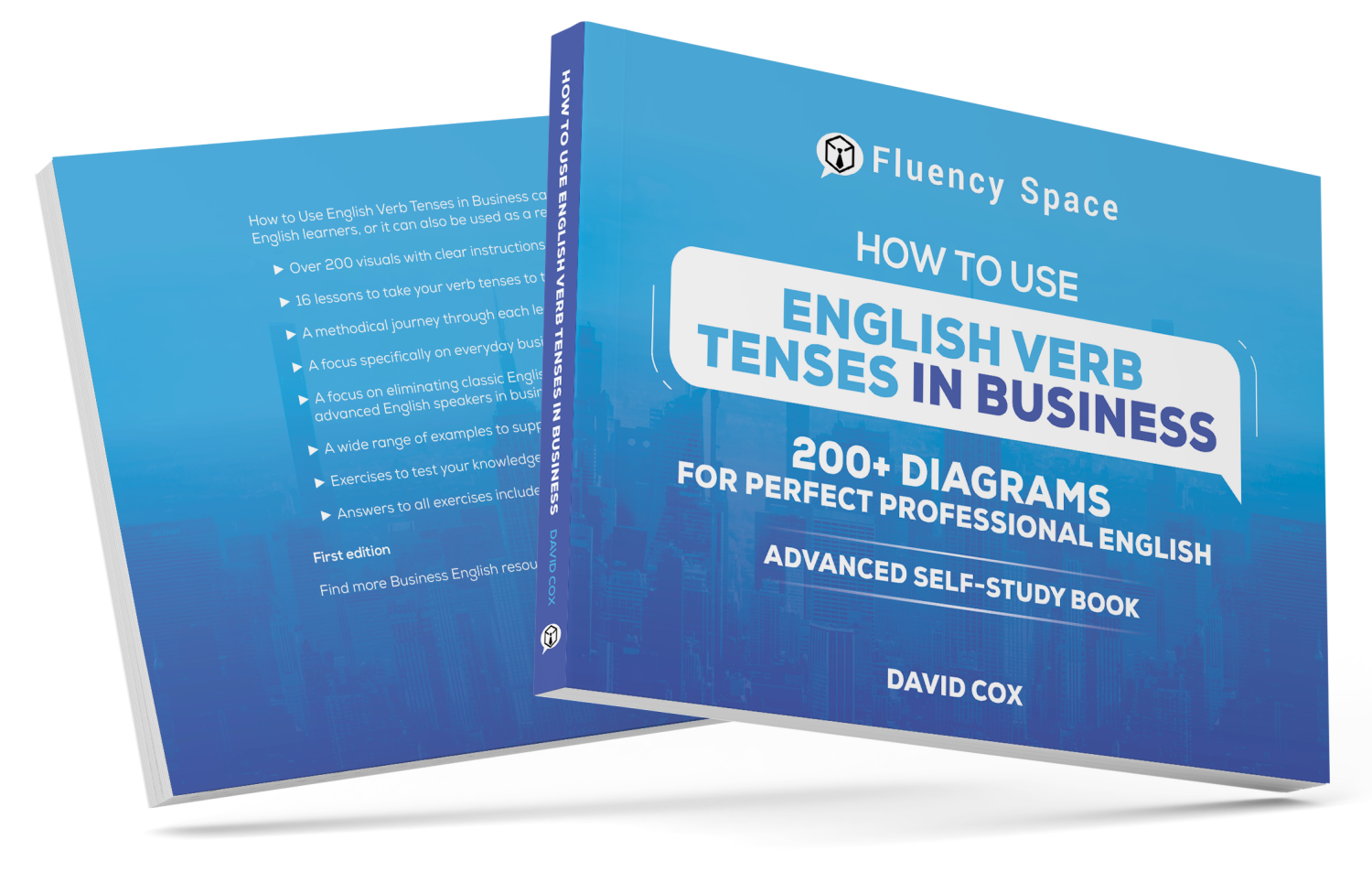
Your advanced English training center. Over 600 pages of PDFs. over 250 diagrams and hundreds of exercises. 32 Vocabulary lessons covering the 400 most important phrases for advanced Business, 2x monthly Adapted Business English texts, 2x monthly YouTube listening lessons, 'How to Use English Verb Tenses in Business' textbook.
All of this and much more for only $5.99 per month. Cancel anytime!