Ernest Shackleton - Exemplary Leadership Lessons From a
Failed Mission
A C1 Business English lesson on crisis leadership, based on Ernest Shackleton’s Endurance expedition of 1914–1916. Written by David Cox, founder of Fluency Space, who has coached C1/C2 executives and senior leaders in Business English for over 14 years.
In 1914 explorer Ernest Shackleton set out to make the first crossing of Antarctica on foot, but his ship, the Endurance, was trapped in pack ice and crushed before it ever reached land. Harvard Business School historian Nancy Koehn has built a case study around the expedition and taught it to executives. This lesson uses the story to build advanced Business English vocabulary and critical thinking for professionals who lead teams through uncertainty.
What business leaders can learn from the story
Shackleton’s story offers three lessons for leaders in a crisis. First, when the original goal becomes impossible, abandon it quickly and set a new one. Second, manage morale as carefully as resources, because routine and shared purpose keep a team functioning under pressure. Third, remember that the leader’s own mood is visible to everyone, so confidence at the top is something the whole team relies on. This C1 Business English lesson provides the vocabulary to discuss crisis management, resilience and team spirit, with practical exercises and a role-play.
Download Lesson
Full lesson including all exercises, answer key and gap-fill. Print-ready format.
Warm up - Before starting the Business English lesson, discuss these with a partner or your teacher.
Henry Ford, the founder of the Ford motor company, once said: "Failure is simply the
opportunity to begin again, this time more intelligently." To what extent do you agree
with that statement, and how do you think we should judge failure in your industry?
In your opinion, how should a leader behave if things are going badly in a company?
Business English Lesson Text - Phrases in bold text will appear in the exercises
In August of 1914, British explorer Ernest Shackleton set out on his mission to be the first
to walk across the continent of Antarctica on foot. The mission was undoubtedly
a colossal failure. His ship, the Endurance, never reached Antarctica. None of its 28 crew
members set foot on the continent, instead having to endure 2 years of horror. Nevertheless, the story of Ernest Shackleton and his failed expedition is one of history's most dramatic and inspiring accounts of leadership in the face of extreme adversity.
The adventure really hit the ground running at the beginning, as the Endurance ship made great progress towards Antarctica. However, the expedition ground to a halt in January 1915, within sight of the Antarctic mainland, when the Endurance became trapped in ice, leaving Shackleton and his 27 crew members completely stranded with no hope of movement until next summer.
Stuck in the ice
Shackleton knew immediately that in order for his team to survive he had to counter the fear, boredom and pessimism which threatened to take hold while stuck in the ice. He gauged that this would pose a greater threat than the cold itself. In order to combat this, he required that each man maintain his ordinary duties as closely as possible. Sailors cleaned the boat; scientists collected samples from the ice; others were assigned to hunt seals and penguins for food. Shackleton insisted on carrying out some of the most difficult tasks himself, showing a willingness to suffer alongside his team and lead by example even in the harshest of situations. He insisted that everyone ate together and socialized after dinner in order to boost team spirit.
Days became weeks, and weeks became months, and still the ice held the ship. By June
1915 — midwinter in the Southern Hemisphere — the ship was weakening under the
pressure created by the ice, and in October water started pouring into the Endurance.
Lessons for today's leaders
Shackleton ordered the crew to leave the sinking ship and make camp on nearby ice with
three small lifeboats, some tents and limited supplies. After another bitter setback, Shackleton stepped up to demonstrate some exemplary leadership qualities, which still
act as a source of inspiration for leaders today:
- The next morning, he immediately announced a new goal: To go home. By immediately setting a goal, he was able to foster a sense of shared mission and a sense of purpose. This also kept his team’s focus on the future. The ship was gone; previous plans were irrelevant. Now his goal was to bring the men home safely, and he improvised, adapted and used every resource at his disposal to achieve it.
- Shackleton realized that he himself had to embody the new survival mission — not only in what he said and did, but also in his energy and mood. He knew that each day, his positive presence had huge impact on the men’s mindsets. He struck a delicate balance of maintaining honesty about the situation, whilst keeping his own confidence and mood high. When his own mood started to dip, he never let his team know.
- When a few team members expressed scepticism about his plans, he acted quickly to contain their opposition and negativity by trying to win them over and keeping close watch on them. He assigned several potential troublemakers to his own tent, so that he could understand their reservations more closely and foster trust.
By April 1916, the ice began breaking up, and Shackleton ordered the men to the lifeboats to find land. After a week of stormy seas, they arrived at the deserted Elephant Island.
Risky calls
At this point, Shackleton again demonstrated his ability to make highly risky calls under
extreme pressure. He knew that the only way to rescue all of the team was to find a
bigger boat. He decided to sail on an 800-mile journey with 5 of his team through some
of the most dangerous seas in the world to South Georgia Island, where he knew he
would find help. This meant leaving 22 men behind on a deserted island, not knowing
whether he would ever return. Such was the trust that Shackleton had built among his
team, along with demonstrations of dedication and commitment, Shackleton’s men were
sure that he would return to rescue them one day.
On South Georgia island, they finally found people, and began looking for a ship to rescue the rest of his team back on Elephant Island. During the next months, he tried to reach there in 3 different ships, but couldn’t cut through the ice nearby. Finally, 4 months later, on Aug. 30, 1916, Shackleton reached the island and rescued all 22 remaining men. After 2 years of hellish conditions, the whole team made it back home safely.
Business English Lesson Vocabulary - Key Words from Context
Match each word to its definition and complete the example sentences. Full Business English lesson with the exercise can be found in the downloadable PDF.
Comprehension - Answer these questions in your own words
QUESTION 1
According to Ernest Shackleton, what was the biggest problem facing the team when
they got stuck in the ice?
QUESTION 2
In what ways was Shackleton able to demonstrate strong leadership qualities when the
ship first got stuck?
QUESTION 3
Based on the context of the sentence, what do you think the phrasal verb ‘stepped up’ means in paragraph 5?
QUESTION 4
Summarize the 3 key takeaways from Shackleton’s leadership after he ordered the crew
to leave the Endurance ship?
QUESTION 5
Why was Shackleton able to leave 22 men alone on a deserted island without
encountering any pushback or resistance?
Business English Lesson Vocabulary in a New Context - Fill in the gaps with words from the vocabulary section
Potential Supply Chain Disruptions
As you may all be aware, there are political tensions in certain seas along our supply chain route from China to Europe. These tensions could severely disrupt operations. As these tensions are getting worse by the day, I believe that they (1) ______________________ to our business, as the whole supply chain could (2) ______________________. In order to (3) ______________________ this threat, I have made a very important (4) ______________________. I have decided to look for a new supplier right here in Europe. I know that some of you will (5) ______________________ have strong (6) ______________________ about this move, because a new supplier is likely to be much more expensive than our current supplier. However, I have calculated all the risks, and I believe that the cost of potential supply chain disruptions will be far greater than a slight increase in the cost of our products. I have calculated the figures and probabilities involved, and I aim to (7) ______________________ any doubters with a compelling presentation.
We need to make sure that any new supplier offers absolutely (8) ______________________ service in order to measure up to the standards of our current supplier.
Discussion - Business insights and takeaways from the text
Shackleton stayed honest about the situation while hiding his own doubts. Where is the line between keeping up morale and withholding information your team has a right to know?
How do you deal with scepticism in your team? Do you bring critics closer, as Shackleton did, or give them more distance?
Leaving 22 men on Elephant Island was a high-risk decision taken under extreme pressure. What is the hardest call you have had to make with incomplete information, and how did you communicate it?
The expedition failed in its original aim, yet Shackleton is remembered as a great leader. Should we judge leaders by their results or by how they handle failure? Would your board agree?
Learn more about making big calls in business with our advanced Business English lesson on the sunk cost fallacy. Learn the psychology behind why leaders make bad decisions
Have you enjoyed this Business English Lesson? Explore more free C1 lessons in our Leadership and communication categories.
Lesson Creator

David Cox
I am a passionate linguist with over 14 years' experience with high level professionals. In this lesson you will learn:
Want to work through this lesson with me?
Advanced Premium Course
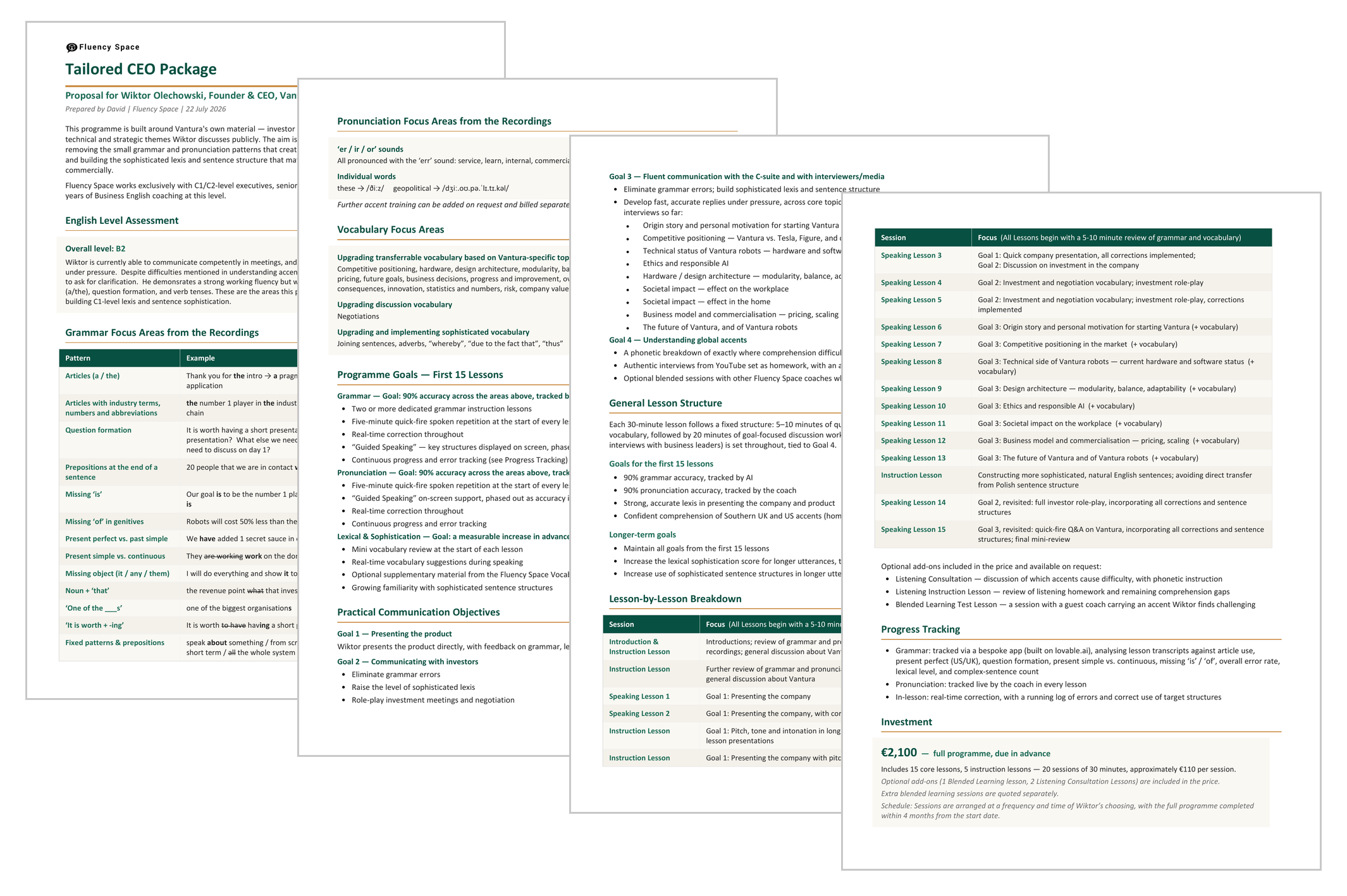
The Fluency Space CEO Package
Enjoyed this lesson? Take your business English further with a structured 3-month programme designed specifically for senior executives.
IN-DEPTH PROPOSAL BUILT WITH CARE
A Course Built around you
After your full English audit, we do a deep dive into your company, your role and your real communication goals - We then build a fully tailored program around them and send a proposal within 3 working days.

© Copyright Fluency Space. All Rights Reserved
OptimizePress Popup Overlay

the fluency space acadademy
Be one of the first 50 to join and get a huge discount!

Your advanced English training center. Over 600 pages of PDFs. over 250 diagrams and hundreds of exercises. 32 Vocabulary lessons covering the 400 most important phrases for advanced Business, 2x monthly Adapted Business English texts, 2x monthly YouTube listening lessons, 'How to Use English Verb Tenses in Business' textbook.
All of this and much more for only $5.99 per month. Cancel anytime!