Connected Speech in English – Adding a /w/ Sound
When we have an a/e/i/o/u sound on the end of a word in English, and then an a/e/i/o/u sound at the beginning of the next word, it is difficult to say the two words together. For example, if you try to say the words "to organise" together, you'll find you have to stop in between the words.
In order to avoid stopping, and to keep the speech nice and fluent, we add in sounds between words that end in a vowel sound and the next word which begins with a vowel sound. When a word ends with an 'o' or 'u' sound, we use a 'w' sound to link it to the next word.
If a word ends in an /o/ or /u/ sound, it doesn't matter which vowel sound the next word begins with — we always use a /w/ to link them. E.g. "go /w/ out" / "go /w/ in." Most words that end with an /o/ or /u/ sound also end with an 'o' or 'u' letter — there aren't many words in English which end this way.
Linking with "to"
To show this in action, here are the most useful English word combinations where we use the /w/ to link the words together. The most common word where we need this is the word "to" — linking to words beginning with a (accept, arrange), e (explain, edit), i (implement, introduce), o (organise, open), and u (understand).
Examples:
"We need to [..w..] accept that we are going to miss the deadline"
"I don't want to [..w..] explain it to him again!"
"We have decided to [..w..] implement the new measures"
"We are going to [..w..] organise an event"
"It is difficult to [..w..] understand"
Other words ending in 'o'
The other main important words ending in 'o' include: go, do, so, also — linking to words beginning with a (at, all, always), e (easy), i (I, in, introduce), o (on, organise), and u (under, understand).
Examples:
"We don't want to go [..w..] over budget"
"I told him to do [..w..] it again"
"I think that the design looks so [..w..] ugly"
"There were limited opportunities for progression in my old position, so [..w..] I decided to look for a new role"
"I also [..w..] explained it very clearly"
Words with an 'o' sound not spelled with 'o'
There are a few important business words which have an 'o' sound at the end of the word, but they aren't spelled with an 'o' — these ones look a bit strange! Through, although, though, thorough — linking to words beginning with a (all, analysis), e (every, each), i (I, it), o (only), and u (understanding).
Examples:
"I am going to go through [..w..] all of the topics we covered in the meeting"
"Even though [..w..] our budget is low, I think this project is feasible"
"We need to carry out a thorough [..w..] analysis"
"I will not say anything, although [..w..] I am quite angry"
The other main sound added between words to link them together in connected speech is a 'y' sound.
Advanced Premium Course
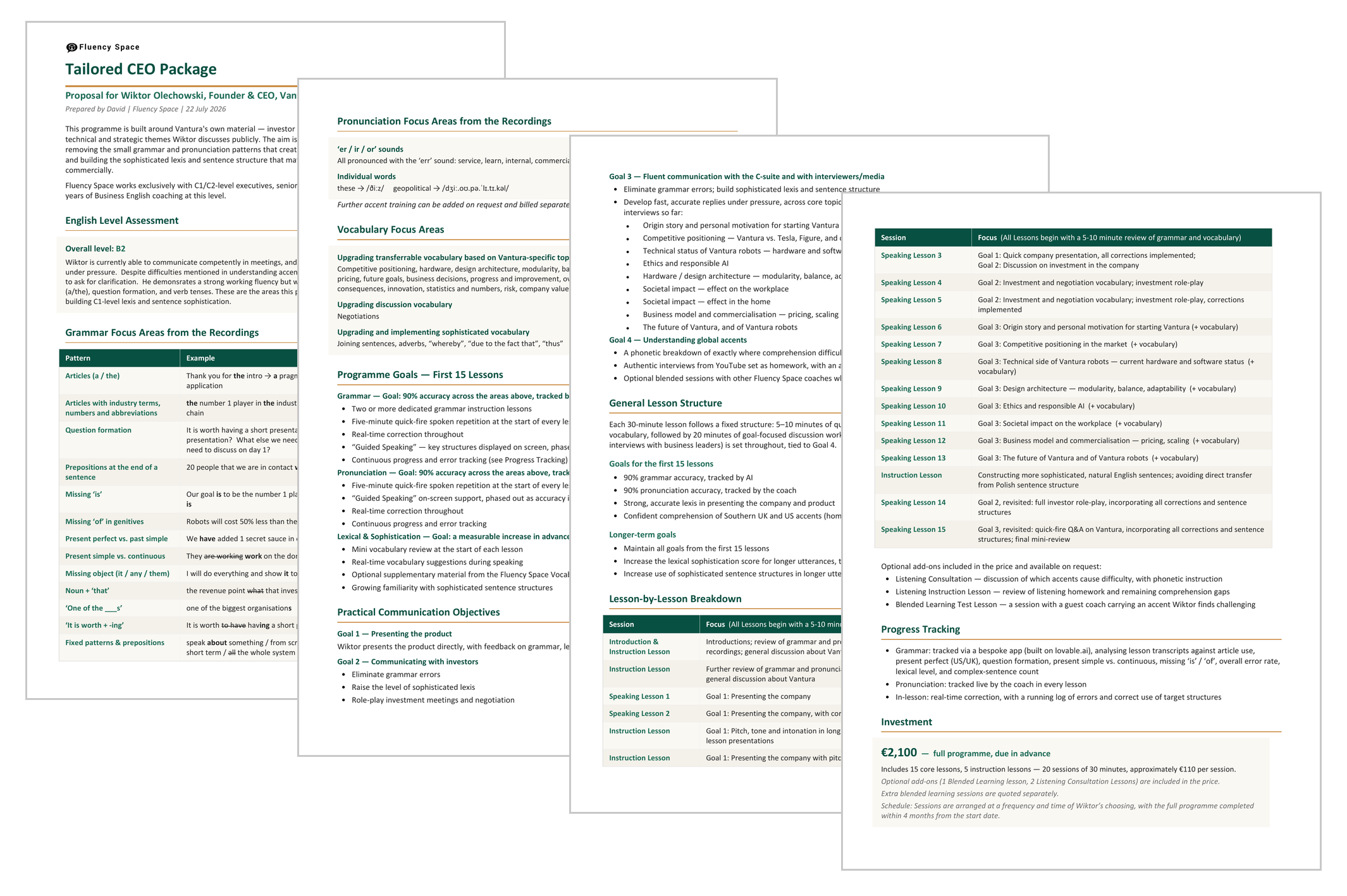
The Fluency Space CEO Package
Enjoyed this lesson? Take your business English further with a structured 3-month programme designed specifically for senior executives.
IN-DEPTH PROPOSAL BUILT WITH CARE
A Course Built around you
After your full English audit, we do a deep dive into your company, your role and your real communication goals - We then build a fully tailored program around them and send a proposal within 3 working days.

© Copyright Fluency Space. All Rights Reserved