Unmanageable or Misunderstood? The Real Reason Managers are Firing Gen Z
A C1 business English lesson on the generational divide in the modern workplace.
Employers say Gen Z hires are difficult to manage. New graduates say they're being set up to fail. This lesson explores the real story behind the dismissal statistics — and what it means for leaders.
The Gen Z firing crisis: a business English lesson on workplace expectations
The Gen Z "quiet firing" trend is a masterclass in mistaking symptoms for causes — and in what happens when organisations treat generational friction as a hiring problem rather than a management one. This C1 business English lesson explores psychological safety, structural onboarding failures, and the language of workplace expectations — essential vocabulary for senior professionals discussing retention, culture and talent strategy at the highest level.
Download Lesson
Full lesson including all exercises, answer key and gap-fill. Print-ready format.
Warm up - Before starting the Business English lesson, discuss these with a partner or your teacher.
In your view, are the values young employees bring to work today fundamentally different from those of previous generations, or simply expressed differently?
Should companies adapt their management style to a new generation of workers, or should employees adapt to existing workplace norms?
Have you ever received feedback at work that felt more like a personal attack than constructive criticism?
What makes a new employee feel that a job is not what they were promised during recruitment?
Business English Lesson Text - Underlined phrases will appear in the exercises
A paradox has emerged at the heart of modern talent management. Organisation that invested heavily in employer branding campaigns to attract digitally native, values-driven graduates are now terminating those same employees at a rate that has alarmed HR professionals. According to a 2024 survey by the consulting firm Intelligent, nearly six in ten employers who hired a recent graduate acknowledged letting them go within a year — a statistic that has sparked fierce debate about
whether the problem lies with the employees, the employers, or the expectations
each brings to the relationship.
The generation in question — broadly those born between 1997 and 2012 —are a generation that I have spent a lot of time teaching. They entered the labour market having internalised a set of workplace values that diverge sharply from those of their predecessors. Raised in an era of radical transparency, they are accustomed to questioning decisions, advocating for their own wellbeing, and declining work they consider unethical or misaligned with their personal values. These behaviours, celebrated in the classroom and lionised on social media, frequently collide with the hierarchical structures and unspoken protocols that still govern most professional environments.
The specific complaints from employers are telling, and align with comments I have heard from managers in my classroom on countless occasions. They report that Gen Z employees resist constructive criticism, interpreting it as a personal attack rather than a professional development opportunity. Others are described as reluctant to engage in tasks they perceive as beneath their qualifications, a phenomenon sometimes labelled role resentment . Perhaps most counterproductive is the tendency — documented across multiple studies — for young workers to air grievances publicly, whether to colleagues, on internal platforms, or even on social media, rather than escalating concerns through established channels.
What these critiques obscure, however, is the degree to which Gen Z's frustrations are well-founded. Many graduates arrive in organisations where onboarding is perfunctory, feedback is infrequent, and progression pathways are opaque. Rather than escalating concerns through channels that rarely seem to exist, they have little choice but to voice them elsewhere. They have been promised meaningful work and a collaborative culture; they often find bureaucracy, micromanagement, and work that bears little resemblance to the role they were sold during recruitment. The resulting disillusionment is predictable, if unfortunate.
A growing body of research suggests that organisations that bridge this gap successfully do so through structural rather than cultural change. Clarity of role expectations from day one, structured feedback cycles, and genuine psychological safety — the assurance that speaking up will not jeopardise one's position — correlate strongly with improved retention. Companies that treat generational friction as a management failure rather than an employee deficiency consistently outperform their peers on engagement metrics.
The broader question, of course, is whether the workplace is simply lagging behind a generation that has already moved on. Gen Z did not invent the concept of work-life integration, nor were they the first cohort to challenge authority. But they are doing so at scale, with unprecedented visibility, and with a level of collective self-advocacy that organisations are, for the most part, ill-equipped to absorb. Those that continue to frame the problem as a question of attitude — and reach for the
dismissal letter — may find that the talent pipeline they are so aggressively cutting off is the same one they will desperately need in five years' time.
6 in 10
Employers who hired a graduate claimed that they let them go within a year.
5 years
Time in which reluctant employers may need to rehire talent that they have let go.
Business English Lesson Vocabulary - Key Words from Context
Match each word to its definition and complete the example sentences. Full Business English lesson with the exercise can be found in the downloadable PDF.
Comprehension - Answer these questions in your own words
QUESTION 1
What statistic does the article cite to demonstrate the scale of early Gen Z dismissals, and what does it suggest?
QUESTION 2
What is meant by 'role resentment', and why might it lead to conflict in the workplace?
QUESTION 3
According to the article, why might Gen Z's frustrations with their employers be considered 'well-founded'?
QUESTION 4
What does the author imply will happen to companies that continue to frame this issue purely as a question of attitude?
Business English Lesson Vocabulary in a New Context - Fill in the gaps with words from the vocabulary section
A Manager Reflects on Losing a New Hire
"Thank you all for meeting today. I want to talk honestly about why we (1) ____________________ Priya's contract after only three months. Her feedback in the exit interview really (2) ____________________ from what I expected. She said she had tried to (3) ____________________ more support early on, but felt our (4) ____________________ made it difficult to be heard. She also described a growing (5) ____________________ after being asked to do basic admin work for weeks. Rather than raising this directly with me, she chose to (6) ____________________ to her colleagues instead of coming to HR — and by the time concerns began to (7) ____________________ , it was already too late. Looking back, I think our (8) ____________________ process let her down: nobody explained her responsibilities clearly in the first month. We also failed to build real (9) ____________________ , so she never felt she could speak up without consequences. I don't want this to become a pattern of (10)____________________ between the younger team and management. Going forward, I want to encourage more (11) ____________________ among new starters, and make sure we're not damaging our (12) ____________________ by losing good people this early."
Discussion - Business insights and takeaways from the text
Do you agree that the workplace is 'lagging behind' a generation that has already moved on? Why or why not?
Should companies treat generational friction as a management failure rather than an employee deficiency? Do you agree with this view?
What structural changes, rather than cultural ones, could most improve the retention of younger employees at your organisation?
Read more about the difficulties facing Gen Z in our advanced Business English lesson on the death of the entry level job.
Check out more key management decisions in our lesson on the sunk cost fallacy.
Have you enjoyed this Business English Lesson? Explore more free C1 lessons in our Leadership and Communication categories.
Lesson Creator

Mike Beattie
I am a passionate linguist with over 10 years' experience with high level professionals around the world. In this lesson you will learn:
Want to work through this lesson with me?
Advanced Premium Course
The Fluency Space CEO Package
Enjoyed this lesson? Take your business English further with a structured 3-month programme designed specifically for senior executives.
IN-DEPTH PROPOSAL BUILT WITH CARE
A Course Built around you
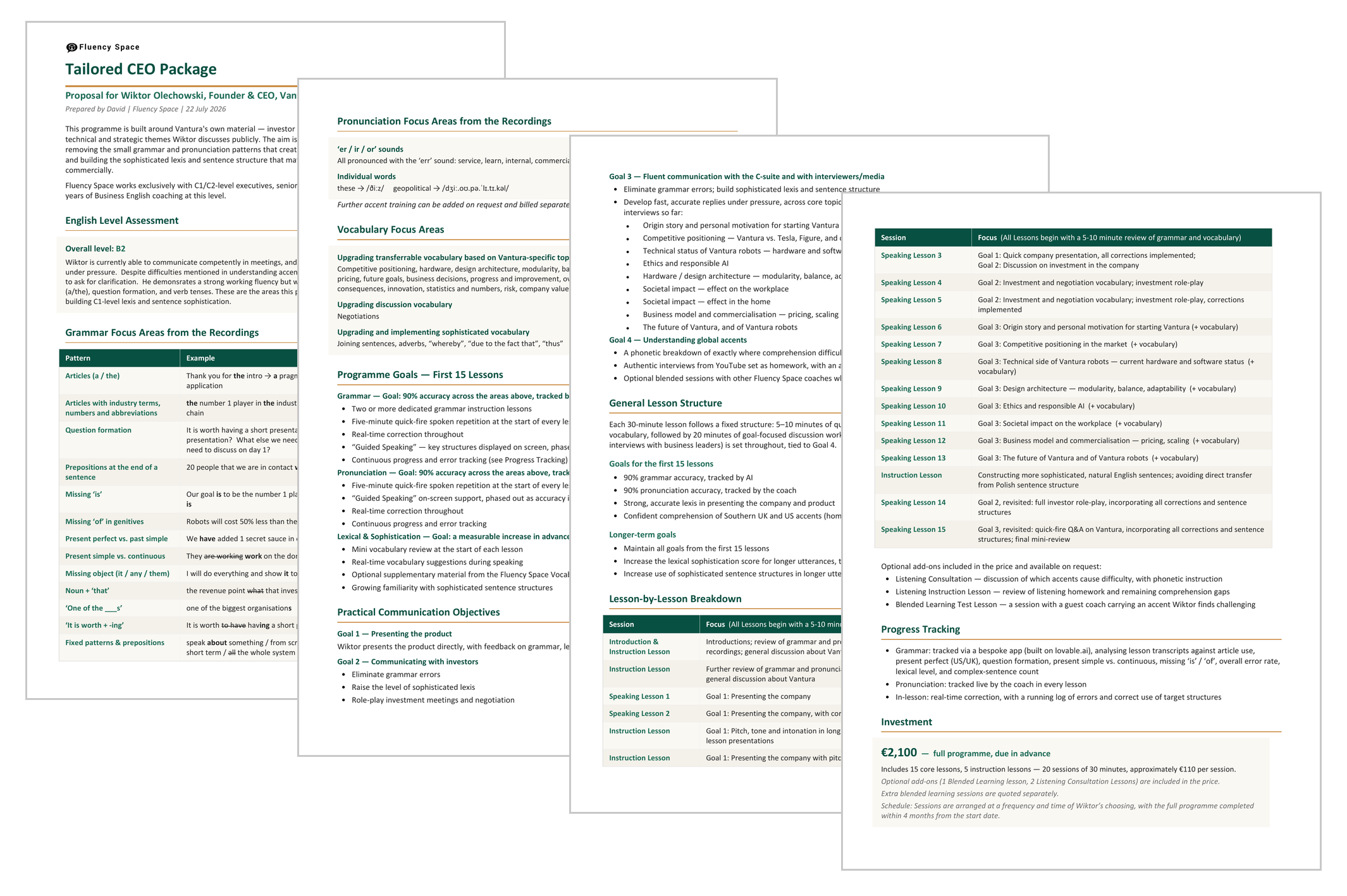
After your full English audit, we do a deep dive into your company, your role and your real communication goals - We then build a fully tailored program around them and send a proposal within 3 working days.

© Copyright Fluency Space. All Rights Reserved
OptimizePress Popup Overlay

the fluency space acadademy
Be one of the first 50 to join and get a huge discount!

Your advanced English training center. Over 600 pages of PDFs. over 250 diagrams and hundreds of exercises. 32 Vocabulary lessons covering the 400 most important phrases for advanced Business, 2x monthly Adapted Business English texts, 2x monthly YouTube listening lessons, 'How to Use English Verb Tenses in Business' textbook.
All of this and much more for only $5.99 per month. Cancel anytime!